

Choosing the right React developers can shape how quickly your product evolves, how well it performs under real-world conditions, and how much effort your team spends maintaining it. For businesses building SaaS platforms, customer portals, eCommerce websites, or internal business applications, the challenge is not simply finding developers who know React. It is finding engineers whose experience matches the product's technical and commercial needs.
React remains a relevant technology for modern web development. In the Stack Overflow Developer Survey 2026, 41.5% of respondents reported using React in their development work over the previous year. Its established ecosystem gives businesses access to a broad range of development tools and engineering practices.
However, hiring decisions should start with the product rather than the technology alone. A startup preparing its first release may need a versatile developer who can turn designs into working features, while an established business may require senior engineers to modernize a complex application.
For companies planning to expand their development capacity, this guide explores how to match React talent to business needs, which international markets are worth considering, and how Bado Tech can help build the right engineering team.
Hiring React Developers Starts with Your Product's Technical Needs
Before publishing a job description or contacting an outsourcing provider, identify the engineering challenges your product needs to solve. The same React skill set can produce very different results depending on the developer's experience, architectural judgment, and ability to work within an existing team.
Match Developer Expertise to the Stage of Your Product
The most effective hiring decision depends on the work ahead, not simply the number of years a candidate has used React.
For an early-stage product, developers may need to build reusable components, connect APIs, implement responsive interfaces, and collaborate closely with product designers. At this stage, adaptability and the ability to deliver complete features can be more valuable than experience with a large enterprise codebase.
For a growing SaaS platform, the requirements often become more demanding. Engineers may need to manage application state, integrate complex APIs, improve loading performance, write automated tests, and establish component patterns that other developers can maintain.
Mature products introduce another set of challenges. Teams may need to refactor legacy code, improve accessibility, reduce unnecessary rendering, or migrate parts of an application without disrupting existing users. These responsibilities call for stronger debugging skills and an understanding of long-term software architecture.
A practical hiring brief should therefore define the product stage, expected responsibilities, technical environment, and delivery outcomes before specifying the required seniority.
Look Beyond React to the Supporting Technology Stack
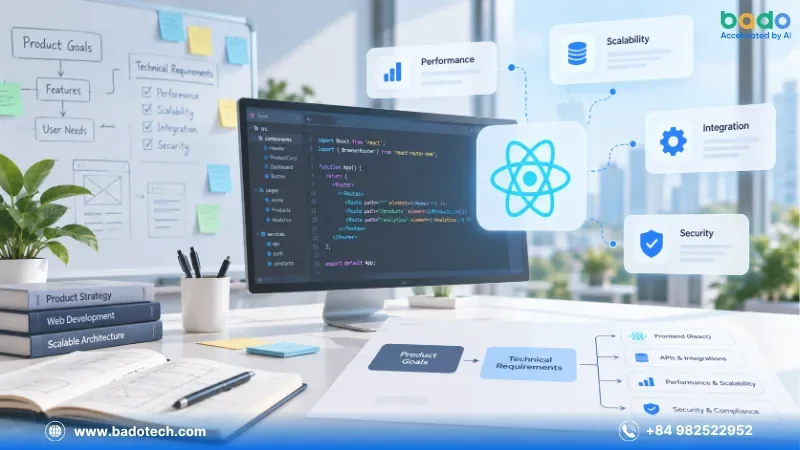
React is only one part of a production web application. Developers often need experience with TypeScript, modern JavaScript, API integration, testing libraries, build tools, and application state management. The exact requirements depend on how the product is structured.
For example, a content-heavy website may benefit from Next.js and appropriate rendering strategies, while a real-time dashboard may place greater emphasis on data updates, state synchronization, and efficient component rendering. An enterprise application could require experience integrating React with .NET APIs, authentication systems, and established back-end services.
When assessing candidates, focus on how they make technical decisions rather than whether they can recite framework concepts. Ask them to explain a performance issue they resolved, how they structure reusable components, or how they prevent changes from breaking existing functionality. This approach helps businesses distinguish developers who can implement isolated tasks from engineers who understand the wider application.
Decide Which Responsibilities Must Stay In-House
Not every development responsibility needs to be handled by the same team. Some companies already have a technical lead and product manager but lack front-end capacity. Others need a partner who can provide several engineers and coordinate delivery across different technical disciplines.
This distinction influences how you hire React developers. If your internal team already owns architecture and sprint planning, adding a specialist may be sufficient. If you are building a product with limited internal engineering resources, a broader team with back-end development, QA, and technical leadership may be more appropriate.
Clarifying these responsibilities early also makes it easier to compare direct recruitment with IT staff augmentation or a dedicated development team without defaulting to a hiring model that creates unnecessary overhead.
Top 5 Southeast Asian Countries to Hire React Developers
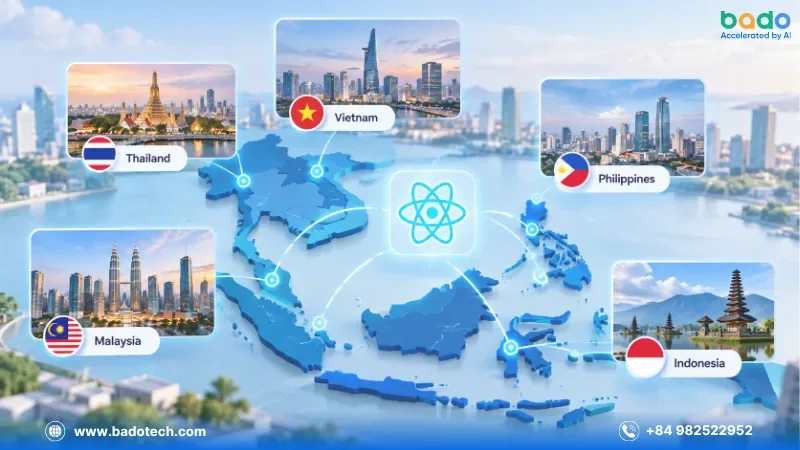
Southeast Asia offers several markets worth evaluating when businesses need to expand their software development capacity. Vietnam, the Philippines, Indonesia, Malaysia, and Thailand each have technology talent pools, but their suitability depends on the required technical expertise, budget, communication needs, and engagement structure.
There is no authoritative ranking that identifies the five Southeast Asian countries with the best React developers specifically. The following comparison is therefore a practical hiring shortlist, not a ranking of developer quality or the number of React specialists in each country.
For broader market context, CBRE's Global Tech Talent Guidebook 2025 examines technology workforce supply, market maturity, education, and labor costs across global technology markets. For Vietnam, the TopDev Vietnam IT & Tech Talent Landscape 2024–2025 report provides additional context on local hiring demand and the software engineering workforce.
1. Vietnam: A Strong Candidate for Outsourced Development
Vietnam is worth considering for businesses seeking outsourced software development, particularly when they want to establish a long-term relationship with an engineering partner. Its technology sector includes software outsourcing providers, product companies, and developers working across web, mobile, cloud, and enterprise applications.
The country's appeal goes beyond the hourly rate. Businesses can explore different team structures, from adding individual specialists to building multidisciplinary teams that include front-end developers, back-end engineers, and QA professionals.
When hiring React developers in Vietnam, assess practical experience with modern JavaScript, TypeScript, component architecture, API integration, testing, and performance optimization. English communication, documentation, and experience working with international stakeholders are also important selection criteria.
For companies evaluating why outsource software development to Vietnam, the key consideration is whether the provider can combine technical capability, transparent delivery, and sustainable team continuity within the required budget.
2. Philippines: English-Language Collaboration
The Philippines is worth exploring when communication with international stakeholders is a central part of the engagement. Businesses developing customer-facing platforms or SaaS products may value developers who can collaborate closely with product managers, designers, and distributed engineering teams.
However, English proficiency should not be treated as a substitute for technical depth. Candidates still need to demonstrate their ability to build maintainable React components, troubleshoot application issues, and contribute to the project's engineering standards. When comparing providers, examine their recruitment process, technical screening, team management, and experience with similar applications.
3. Indonesia: A Market for Growing Digital Products
Indonesia is another market to consider for businesses looking to expand their software development resources. Its growing digital economy creates demand for web applications, eCommerce platforms, and business software, making it relevant to companies exploring regional engineering options.
For React projects, the selection process should focus on the available talent's specific experience rather than broad assumptions about the country's technology sector. Evaluate candidates on API integration, responsive design, testing, and their ability to work within the existing back-end architecture.
Companies should also clarify working hours, communication expectations, and delivery responsibilities before committing to a long-term engagement.
4. Malaysia: Regional Collaboration and Technical Specialization
Malaysia may suit businesses that want to explore a regional technology partner or hire developers with experience supporting international and enterprise-oriented projects.
The most relevant consideration is the team's fit with your technology stack and delivery model. For example, a business integrating React with established enterprise systems may prioritize developers who understand authentication, API contracts, testing, and maintainable front-end architecture. Compare the actual scope of services, team seniority, and total engagement cost rather than assuming that providers in the same country offer equivalent capabilities.
5. Thailand: An Additional Option for Regional Hiring
Thailand is another market worth including when evaluating Southeast Asian software development resources. Depending on the provider and available candidates, businesses may explore teams for web applications, digital services, and customer-facing products.
The same technical screening standards should apply across all five markets. A developer's ability to explain implementation decisions, maintain code quality, work with designers, and troubleshoot production issues is more meaningful than geographic location alone.
Businesses should also confirm English communication, availability, time-zone overlap, and experience with international development processes before choosing a partner.
How to Compare These Five Markets Fairly
Country-level comparisons are useful for creating a shortlist, but they cannot determine the best hiring decision on their own. The actual cost and quality of a React development engagement depend on seniority, project complexity, provider structure, and the amount of management support included.
When comparing Vietnam with the Philippines, Indonesia, Malaysia, and Thailand, consider the following dimensions:
- Technical capability: Evaluate demonstrated React experience, testing practices, architecture knowledge, and the ability to solve relevant engineering problems.
- Total cost: Compare the full engagement cost, including recruitment, management, onboarding, infrastructure, and any additional fees, rather than relying only on hourly rates.
- Communication: Assess English proficiency, documentation quality, meeting practices, and the team's ability to clarify requirements.
- Delivery structure: Determine whether the provider offers individual developers, staff augmentation, or a dedicated team with complementary technical roles.
- Continuity and scalability: Check how the provider handles replacement, knowledge transfer, team expansion, and ongoing maintenance.
This framework makes the comparison more meaningful than a generic country ranking. It also helps businesses determine whether to recruit locally, hire developers in Vietnam, or explore another regional market based on the actual needs of the product.
Turn Your Hiring Requirements into a Development Team with Bado Tech
Once the technical requirements and target market are clear, the next step is finding a team that can deliver against them. A successful engagement needs more than suitable CVs: it requires a clear scope, agreed responsibilities, a reliable selection process, and a working arrangement that supports the product beyond its initial release.
Choose the Right Developer Profile for Your Project
Bado Tech provides hiring options across several technical disciplines, allowing businesses to explore different ways of extending their engineering capacity.
- React and JavaScript developers: Build and maintain modern web interfaces, integrate APIs, and develop interactive applications.
- .NET developers: Develop back-end services, enterprise applications, and API-driven systems that support React front ends.
- Flutter and mobile developers: Build cross-platform mobile applications and extend digital products beyond the browser.
- QA engineers: Strengthen testing processes, identify defects, and support more reliable releases.
- DevOps engineers: Improve deployment workflows, infrastructure management, and continuous integration and delivery.
- AI engineers: Explore AI-powered features and integrate suitable AI capabilities into business applications.
The right combination depends on whether you need additional front-end capacity, a multidisciplinary team, or ongoing support for a larger software product.
Build an Engagement Around Delivery Outcomes
Before starting, define the expected deliverables, communication schedule, acceptance criteria, and technical responsibilities. These details help both parties establish a shared understanding of progress and reduce the risk of unclear requirements during development.
For companies with an established engineering team, IT staff augmentation may provide the additional React expertise needed to complete a specific workstream. For businesses seeking sustained development capacity, a dedicated team can bring together complementary roles under a longer-term arrangement.
Whichever model you choose, agree on code ownership, documentation, security requirements, access controls, and knowledge transfer. These considerations are especially important when an external team will contribute to software that the business must maintain and evolve.
Looking for React developers who fit your product requirements? Contact Bado Tech to discuss your project scope, preferred technology stack, team structure, and delivery timeline.
Conclusion
Hiring the right React developers requires more than comparing technical skills or hourly rates. Businesses should consider product requirements, engineering experience, communication, and long-term scalability when choosing a hiring market or development partner. For companies seeking flexible software development capacity in Southeast Asia, Vietnam is a market worth exploring. With the right team and engagement model, Bado Tech can help turn your product requirements into reliable, scalable web applications.
Frequently Asked Questions
1. What skills should you look for when hiring React developers?
Prioritize React, JavaScript or TypeScript, component architecture, API integration, testing, and performance optimization. Additional requirements depend on your framework, application complexity, and existing engineering stack.
2. Which Southeast Asian countries are worth considering when hiring React developers?
Vietnam, the Philippines, Indonesia, Malaysia, and Thailand are five markets worth exploring. They should not be interpreted as a definitive ranking of developer quality or React talent availability.
3. Is it better to hire React developers directly or outsource?
Direct hiring provides greater control over permanent team building. Outsourcing can provide access to additional technical capacity and complementary roles, while the best option depends on project duration, internal management capabilities, and delivery requirements.