

Businesses today need to develop digital products faster while keeping costs under control. However, finding experienced software developers, filling technical skill gaps, and scaling an engineering team can be challenging, especially when internal recruitment takes too much time.
IT staff augmentation offers a flexible way to address these challenges. Instead of building an entirely new in-house team or outsourcing an entire project, businesses can bring in external IT professionals to work alongside their existing employees and support specific development goals.
In this guide, we will explain what IT staff augmentation is, explore its key benefits, and show how Bado Tech helps businesses access software development expertise in Vietnam through flexible technology services.
1. What Is IT Staff Augmentation?
IT staff augmentation is a flexible hiring model that allows businesses to extend their existing technology teams with external IT professionals for a specific period or project. These professionals work alongside the company's in-house team, contributing their technical skills to ongoing software development, system maintenance, testing, or other technology initiatives.
Unlike traditional recruitment, which requires businesses to hire permanent employees, IT staff augmentation provides access to additional talent without the same long-term employment commitment. Companies can scale their teams according to project requirements, fill specialized skill gaps, and maintain control over development priorities.
For example, a company developing a new SaaS platform may have an experienced product manager and several backend developers but lack frontend expertise. By choosing IT staff augmentation, the company can hire experienced frontend developers to support the project without launching a lengthy recruitment process.
How Does IT Staff Augmentation Work?
The IT staff augmentation process typically begins with identifying the technical skills, experience levels, and team capacity required to achieve business objectives. A company then works with a technology partner to identify suitable professionals, evaluate their qualifications, and select candidates who fit the project's requirements. Once the team members are onboarded, they collaborate with the client's internal team through its existing communication channels, project management tools, and development workflows.
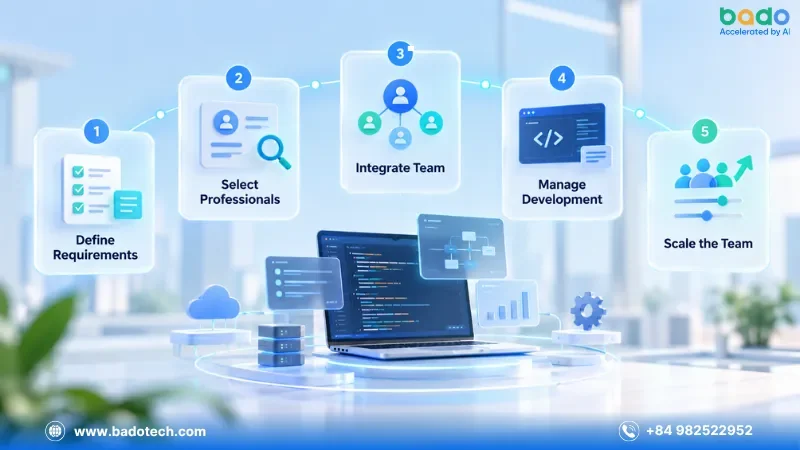
A typical engagement follows these steps:
- Define technical requirements: Identify the roles, skills, experience, and project duration needed.
- Select suitable professionals: Review candidates based on their technical expertise, communication skills, and ability to work within the existing team.
- Integrate the augmented team: Establish responsibilities, access permissions, development standards, and communication processes.
- Manage development activities: Assign tasks, monitor progress, conduct code reviews, and maintain quality standards.
- Scale or adjust the team: Add specialists, change team capacity, or conclude the engagement as project requirements evolve.
The main advantage is that the client retains control over project priorities and day-to-day development decisions while gaining access to additional technical capabilities.
Flexible Hiring and Team Expansion
Building an internal engineering department can take time, particularly when a company needs several specialized roles at once. Working with an external development partner can provide another way to access talent without managing every part of recruitment independently.
Depending on the project, businesses may hire individual developers, add external engineers to an existing team, or engage a provider to deliver a defined software project.
These options allow companies to adjust their engineering capacity according to business priorities. The right arrangement depends on how much direct control the internal team needs and who will be responsible for planning, execution, and delivery.
IT Staff Augmentation vs. Traditional Hiring
Traditional recruitment is often suitable when a company needs permanent employees who will contribute to its long-term organizational structure. However, it may not be the most efficient option when a project requires additional developers for only a few months or demands skills that the current team does not possess.
IT staff augmentation provides an alternative by allowing businesses to access external talent without expanding their permanent workforce for every new requirement. For example, a company can augment its team with a DevOps engineer during a cloud migration or bring in additional QA engineers before a major product release. Once the requirement has been fulfilled, the engagement can be adjusted according to the agreement.
This model is particularly useful for companies experiencing fluctuating workloads, rapid product growth, or temporary shortages of specialized technical skills.
IT Staff Augmentation vs. Other Software Outsourcing Models
IT staff augmentation is one of several software outsourcing models available to businesses. Choosing the right approach depends on how much control the client wants to retain, the scope of the work, and the level of responsibility assigned to the external partner.
These models serve different business needs. Staff augmentation offers flexibility and direct involvement, while project-based outsourcing can reduce the client's day-to-day management responsibilities. A dedicated development team can provide greater continuity when a product requires sustained engineering support.
Understanding these differences helps businesses select a suitable engagement model rather than choosing a solution based solely on its initial cost.
2. Why Should Businesses Use IT Staff Augmentation Services?
IT staff augmentation serves not only to increase the number of developers but also as a strategic approach to managing technical capacity, accessing specialized expertise, and responding to ever-changing business requirements.
When roles and responsibilities are clearly defined and coordination is effective, this model can help businesses accelerate development progress while maintaining control over their own technology roadmap.
Access Specialized Software Development Expertise
One of the biggest challenges in software development is finding professionals with the right technical background at the right time. Projects involving artificial intelligence, cloud infrastructure, system integration, cybersecurity, or complex application architecture may require expertise that an existing team does not have.
IT staff augmentation enables businesses to access professionals with relevant experience without recruiting every specialist as a permanent employee.
For instance, a company modernizing a legacy application may need experienced backend developers and cloud engineers during a specific development phase. An augmented team can provide those capabilities while the company's internal employees continue managing product strategy and business operations.
This approach is especially valuable when technical requirements change throughout the product lifecycle. Instead of maintaining every possible skill set internally, businesses can obtain the software development expertise needed for each stage.
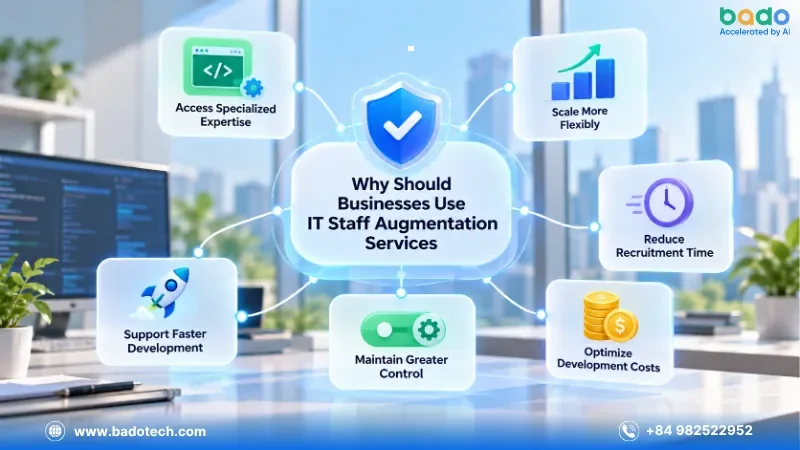
Scale Development Capacity More Flexibly
Development workloads rarely remain constant. A company may need a small engineering team during product discovery, additional developers during implementation, and more QA engineers before release.
Traditional hiring can make these changes difficult because permanent recruitment requires time and creates ongoing workforce commitments.
With IT staff augmentation, businesses can adjust team capacity according to project priorities and available resources. They can add developers to address an urgent backlog, introduce specialists for a technical upgrade, or increase testing capacity before launch.
This flexibility helps organizations respond to new opportunities without making every staffing decision a permanent commitment. However, scaling successfully still requires planning. Businesses should define onboarding procedures, documentation standards, access permissions, and knowledge-transfer processes before expanding the team.
Reduce Recruitment Time and Administrative Work
Recruiting experienced software developers involves more than publishing job advertisements. Companies must source candidates, screen applications, conduct technical interviews, evaluate cultural fit, and manage onboarding.
These activities can place a significant burden on internal HR teams and engineering managers, particularly when several specialized roles need to be filled simultaneously.
Working with an IT staff augmentation provider can simplify the process by giving businesses access to a pool of pre-screened candidates. The client can focus on evaluating relevant candidates rather than managing every stage of sourcing independently.
This does not eliminate selection or onboarding requirements. Businesses should still assess technical capabilities, communication skills, security awareness, and compatibility with their development processes.
Nevertheless, a well-managed augmentation engagement can reduce recruitment friction and help the internal team focus on delivering business value.
Optimize Software Development Costs
Hiring full-time employees involves costs beyond base salaries, including recruitment, onboarding, employee benefits, equipment, training, and other employment-related expenses.
IT staff augmentation offers an alternative when companies need specific expertise or additional capacity for a defined period. Rather than expanding the permanent workforce for every project, businesses can allocate resources according to actual development requirements.
For companies looking to hire developers in Vietnam, this model may also provide access to a broader talent market and different cost structures compared with recruiting exclusively in their home markets.
However, cost efficiency should not be measured by hourly rates alone. Businesses need to consider the provider's technical quality, onboarding time, communication effectiveness, team continuity, and the potential cost of rework.
A lower-cost engagement may become more expensive if developers lack the required expertise or if collaboration problems delay delivery. The objective should therefore be to maximize engineering value, not simply minimize the initial staffing budget.
Maintain Greater Control Over Development
Some businesses prefer software outsourcing but do not want to hand over all development decisions to an external provider.
IT staff augmentation addresses this concern by allowing external professionals to work within the client's existing development structure. Internal product managers, technical leads, and engineering managers can continue assigning tasks, prioritizing the backlog, reviewing code, and making architectural decisions.
This arrangement can be particularly useful for organizations with established product management practices that need additional engineering capacity rather than a completely outsourced delivery function.
To make the arrangement effective, both parties should agree on reporting lines, task ownership, communication schedules, code review standards, and performance expectations from the beginning.
The client should also ensure that external team members receive sufficient documentation and technical guidance to contribute without creating unnecessary management overhead.
Support Faster Product Development and Innovation
Product launches, feature releases, and digital transformation initiatives often depend on whether the right technical skills are available at the right stage.
When internal teams lack capacity, development backlogs can grow and important initiatives may be delayed. Adding suitable developers can help distribute workloads, address technical bottlenecks, and maintain progress toward release milestones.
For example, a startup preparing to launch a minimum viable product (MVP) may augment its existing team with mobile developers or QA engineers to complete critical development tasks. An established business may add AI engineers to explore intelligent automation without interrupting its core product roadmap.
The benefits depend on how well the augmented professionals integrate into the team's workflow. Additional headcount alone does not guarantee faster delivery; clear requirements, sound technical leadership, and effective collaboration remain essential.
When Is IT Staff Augmentation the Right Choice?
IT staff augmentation is particularly suitable when a business has an existing development team but needs additional capacity or specialized expertise. Common scenarios include:
- Filling temporary gaps in frontend, backend, mobile, QA, DevOps, or AI engineering roles
- Accelerating a software release without expanding the permanent workforce
- Supporting cloud migration, system integration, or application modernization
- Extending an internal team during periods of rapid business growth
- Accessing international talent when local recruitment is challenging
- Maintaining direct control over product development and technical decisions
On the other hand, businesses without an internal technical lead or those seeking a provider to take full responsibility for project delivery may benefit more from a dedicated development team or project-based outsourcing arrangement.
The best model depends on the company's technical maturity, management capacity, project scope, and long-term objectives.
3. Bado Tech: A Trusted Software Outsourcing Partner in Vietnam
Choosing an IT staff augmentation provider involves more than finding available developers. Businesses need a technology partner that understands their objectives, can supply relevant technical expertise, and supports effective collaboration throughout the engagement.
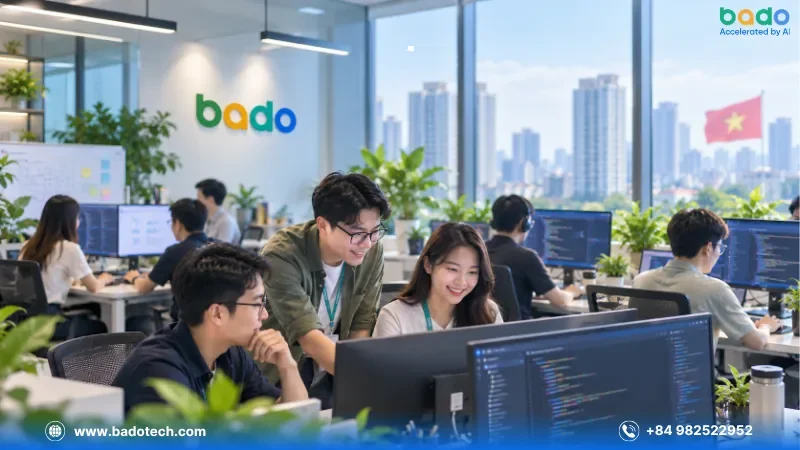
Bado Tech helps businesses access software development capabilities through flexible technology services, including IT staff augmentation, dedicated development resources, product development, and AI engineering.
For companies looking to hire software developers or expand their engineering capabilities internationally, working with a software outsourcing partner in Vietnam can provide another way to build and scale technology teams. Explore the full range of outsourcing services:
IT Staff Augmentation
Bado Tech's IT staff augmentation service helps businesses extend their existing teams with technical professionals aligned with their development requirements.
Augmented professionals contribute to its existing workflows and support specific technical objectives. This arrangement can help businesses address resource shortages, introduce specialized expertise, and adjust team capacity as projects evolve.
Depending on project requirements, businesses may need professionals across software engineering, AI and system integration, quality engineering, or cloud and infrastructure. This service is suitable for organizations that want to retain control over development priorities while accessing additional technical capabilities through an external partner.
Dedicated Developers
Dedicated developers is an option for businesses that need individual developers to focus on their products or ongoing engineering work.
Companies can seek developers with relevant technical skills and experience to support established development processes, work through product backlogs, and contribute to continuous improvement.
Compared with broader staff augmentation requirements, hiring dedicated developers can be particularly appropriate when the priority is securing consistent individual contributors for ongoing work.
Dedicated Development Teams
A dedicated development team provides a more comprehensive team-based approach to software engineering. Instead of adding only one or two specialists, businesses can work with a dedicated group of professionals aligned with their product goals and development roadmap.
Depending on the project, the team may include developers, QA engineers, and other technical specialists with complementary skills. This structure can support continuous development, feature expansion, and longer-term product initiatives.
For businesses planning substantial development work, a dedicated team can offer greater continuity and a more structured collaboration model than hiring individual resources independently.
Rapid MVP Development
Rapid MVP Development helps businesses turn product ideas into an initial working version that can be evaluated and tested before committing to a larger development investment.
Building an MVP requires more than writing code. Businesses need to identify the core problem, prioritize essential functionality, select an appropriate technical approach, and establish a realistic delivery scope.
A structured MVP development process helps teams focus on the most important product assumptions and avoid spending too much time building features before validating their value.
For startups and established businesses exploring new opportunities, this approach can support earlier feedback and more informed decisions about future product investment.
Product Development
Product Development supports businesses throughout the process of designing, building, improving, and maintaining software products. Depending on the project's scope, this can involve application architecture, frontend and backend development, integrations, testing, deployment, and ongoing enhancements.
A well-defined product development approach connects technical decisions with business objectives. It considers scalability, maintainability, user requirements, and the product's expected evolution rather than focusing exclusively on the initial release.
For organizations that need an external engineering partner, product development can provide a structured way to turn requirements into functional digital solutions and continue improving them as business needs change.
AI Engineering
AI Engineering helps businesses explore and implement AI-powered capabilities within their digital products, internal systems, and business workflows. Depending on the use case, AI initiatives may involve integrating AI models, developing intelligent applications, automating selected tasks, or connecting AI capabilities with existing software systems.
Successful implementation requires more than selecting a model or building a prototype. Businesses must also consider data quality, system integration, reliability, security, performance, and how the resulting solution fits into existing operations.
By combining software engineering with appropriate AI technologies, organizations can explore practical applications while maintaining a focus on business requirements and long-term system maintainability.
These services can address different stages of a software initiative, from validating an early-stage concept to expanding an established engineering team or introducing new technology capabilities.
Businesses should evaluate their internal resources, delivery expectations, technical complexity, and preferred level of management before choosing an engagement model. To discuss your requirements and explore the available options, contact Bado Tech for details.
Conclusion
IT staff augmentation offers businesses a practical way to increase engineering capacity, access specialized software development expertise, and respond to changing project requirements without relying exclusively on permanent recruitment.
Bado Tech provides a range of technology services to support different business needs, from IT staff augmentation and dedicated developers to MVP development, product development, and AI engineering. This is a partner worth considering if you are looking for outsourcing services in Vietnam.
Frequently Asked Questions
1. What is IT staff augmentation in simple terms?
IT staff augmentation is a hiring model that allows businesses to add external IT professionals to their existing teams for a defined period or project. These professionals contribute technical expertise while the client generally retains control over development priorities and daily tasks.
2. Is IT staff augmentation cost-effective?
It can be cost-effective when businesses need specialized skills or additional development capacity without making permanent hires. However, total cost depends on developer experience, engagement duration, onboarding, management effort, and delivery quality.
3. Why should businesses hire developers in Vietnam?
Vietnam can be an option for businesses seeking access to international software engineering talent and alternative development cost structures. Companies should assess each provider's technical expertise, communication skills, development practices, security standards, and ability to support their specific requirements.