

Choosing between staff augmentation and software outsourcing can significantly affect your development costs, project timelines, and product quality. Both models help businesses access skilled developers without building an entire in-house team, but they differ in how work is managed, who takes responsibility for delivery, and how much control you retain.
For companies looking to scale engineering teams, hire software developers with specialized skills, or build a new digital product, understanding these differences is essential. The right approach depends on your internal capabilities, project requirements, available budget, and long-term business goals.
In this guide, we compare staff augmentation vs outsourcing across key factors, explain when each model works best, and explore how businesses can work with a software development partner in Vietnam to achieve their objectives.
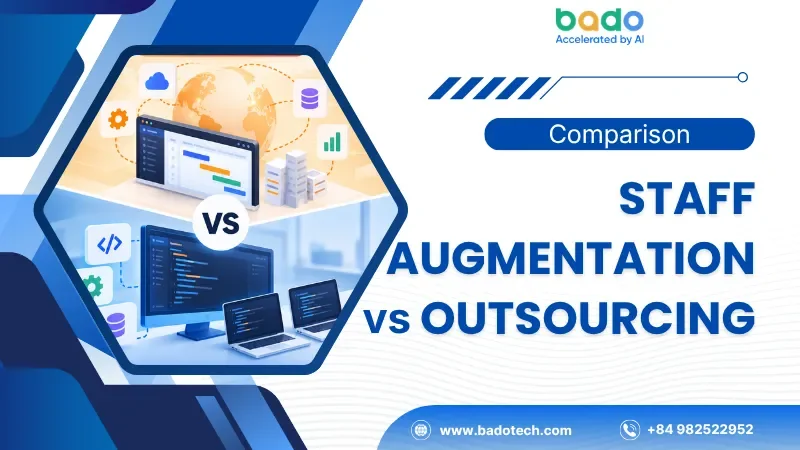
What Is Staff Augmentation?
Staff augmentation is a software development model in which a business brings external professionals into its existing team to fill skill gaps or increase development capacity. These professionals work under the client's day-to-day direction and follow its established workflows, tools, and technical standards.
Instead of recruiting permanent employees, companies can access qualified engineers through a service provider for a defined period or an ongoing engagement.
How Staff Augmentation Works
Under a typical staff augmentation arrangement, the client identifies the required roles, evaluates candidates, and selects developers based on their technical skills and project experience. Once onboarded, external developers collaborate with internal employees and report to the client's engineering manager or technical lead.
For example, a company developing a web application may need additional .NET developers to accelerate backend development. Rather than spending months recruiting full-time employees, the company can bring in external engineers who contribute directly to its existing codebase.
This model is particularly useful when businesses already have a product roadmap, technical leadership, and established development processes but need additional resources to execute their plans.
Benefits of Staff Augmentation
The main advantage of staff augmentation is flexibility. Businesses can expand their teams when workloads increase and adjust capacity as project requirements change. Other benefits include:
- Direct control: Internal managers retain responsibility for priorities, workflows, and technical decisions.
- Access to specialized skills: Companies can find engineers with experience in specific technologies, frameworks, or industries.
- Faster team expansion: External recruitment can help fill immediate capacity gaps without relying entirely on traditional hiring.
- Knowledge retention: Developers contribute within the client's environment, helping internal teams retain technical knowledge and ownership of the product.
- Flexible engagement: Businesses can engage professionals for short-term assignments or longer development cycles.
What Is Software Outsourcing?
Software outsourcing is a business arrangement in which a company delegates some or all software development activities to an external provider. Depending on the agreement, the provider may be responsible for project planning, team management, development, quality assurance, deployment, and ongoing maintenance.
Unlike staff augmentation, traditional project-based outsourcing places greater responsibility for execution on the external partner.
This model is suitable for businesses that want to build a digital product, develop a new application, modernize an existing system, or deliver a defined technical initiative without managing every developer directly.
How Software Outsourcing Works
The process typically begins with business requirements, project objectives, expected deliverables, and technical constraints. The outsourcing provider then proposes a suitable team, delivery approach, timeline, and pricing structure.
Once the engagement begins, the provider manages the development process according to the agreed scope and responsibilities. The client remains involved through progress meetings, milestone reviews, product demonstrations, and acceptance testing.
For example, a startup may outsource the development of a mobile application because it lacks an internal engineering department. The software development partner can provide the necessary developers, project management, and quality assurance capabilities to deliver the application.
The level of responsibility transferred depends on the engagement model. Fixed-scope outsourcing, dedicated development teams, and managed delivery arrangements do not all operate in the same way.
Benefits of Software Outsourcing
Software outsourcing allows businesses to access broader technical capabilities without establishing every function internally. Its main advantages include:
- Reduced management overhead: The provider manages day-to-day development activities within the agreed scope.
- Access to broader expertise: Businesses can work with teams covering backend development, frontend engineering, mobile applications, QA, and DevOps.
- Coordinated delivery: Project management and technical execution can be organized under one delivery partner.
- Predictable milestones: Defined deliverables and acceptance criteria make it easier to track progress.
- Flexible access to resources: Companies can access the capabilities required for a project without maintaining the same team permanently.
Outsourcing still requires active client participation. Clear requirements, timely feedback, appropriate governance, and agreed communication processes remain essential to project success.
>> View more: Software Outsourcing Models: How to Choose the Right One for Your Business
Staff Augmentation vs Outsourcing: Key Differences
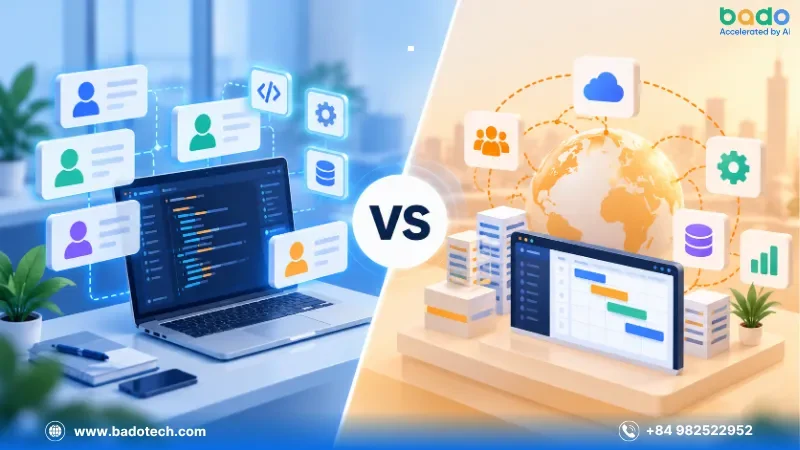
Although both approaches provide access to external software development talent, the main difference lies in who manages the work and who is responsible for delivery. The following comparison highlights the most important factors businesses should evaluate before choosing a model.
Neither model is universally better. Staff augmentation offers greater direct control, while project outsourcing can reduce the internal effort required to coordinate software delivery. The appropriate choice depends on the capabilities your business already has and the responsibilities you want to retain.
Staff Augmentation vs Outsourcing: Cost Comparison
Cost is an important consideration, but comparing the quoted developer rate with the total outsourcing price can be misleading. Businesses should evaluate the overall cost of delivering and maintaining the software.
Staff Augmentation Costs
Staff augmentation is commonly priced according to the number of developers, their seniority, engagement duration, and technical specialization.
The client should also account for internal management, onboarding, code reviews, infrastructure, and other operational expenses. If requirements change frequently, this model can offer useful flexibility because the team can adjust priorities without renegotiating a complete project scope.
However, a lower hourly rate does not necessarily mean a lower total cost. If internal management is limited or the team lacks technical leadership, development may take longer than expected.
Software Outsourcing Costs
Outsourcing costs depend on the project scope, technical complexity, team composition, delivery timeline, and level of responsibility assigned to the provider.
Fixed-price contracts can improve budget predictability when requirements and acceptance criteria are sufficiently clear. Time-and-materials agreements may be more appropriate for projects with evolving requirements, while milestone-based arrangements can link payments to agreed delivery stages.
Businesses should review what the proposal includes, such as project management, QA, documentation, deployment, maintenance, and post-launch support.
Staff augmentation is often easier to adjust at the resource level, while outsourcing can make delivery responsibilities and project costs easier to define upfront. Neither model guarantees lower costs without effective planning and execution.
When Should You Choose Staff Augmentation?
Staff augmentation is generally the better option when your business already has the structure needed to manage software development but lacks enough people or specific technical skills. Consider this model in the following situations.
You Already Have an In-House Development Team
If your engineering team manages the product roadmap, architecture, and development process, adding external engineers can increase capacity without changing the existing operating model. For example, your team may need additional developers to complete a product release, resolve technical debt, or support a growing backlog.
You Need Specialized Technical Expertise
Some projects require skills that are difficult to source quickly through conventional recruitment. A business may need .NET developers to extend an enterprise application, React developers to improve its frontend, or engineers experienced in cloud infrastructure. Staff augmentation helps bring those capabilities into the team while allowing internal technical leaders to retain control.
Your Requirements Change Frequently
Products in active development often require ongoing adjustments based on user feedback, business priorities, or technical discoveries. Because the client manages the developers directly, staff augmentation can make it easier to change assignments and priorities without redefining an entire outsourced project scope.
You Want to Retain Technical Ownership
Businesses developing core products may want internal teams to retain architectural knowledge, control repositories, and manage future development independently. Staff augmentation supports this approach when external engineers work within the client's systems and follow its documentation, security, and code review practices.
When Should You Choose Software Outsourcing?
Software outsourcing is often a better fit when a business needs an external partner to organize and deliver a defined software initiative. It can be particularly valuable when the company lacks sufficient internal engineering resources or prefers to focus on business strategy rather than day-to-day development management.
You Need to Build a Product From Scratch
Startups and established businesses may have a product concept but lack the developers, designers, QA specialists, and technical leadership required to turn it into a working application. A software outsourcing partner can help translate business requirements into a development plan and coordinate the delivery process from discovery through deployment.
You Lack Internal Technical Leadership
Hiring individual developers is not always enough to deliver a successful product. Software development also requires architecture decisions, project planning, testing, release management, and coordination across disciplines. If your company does not have an experienced technical lead or engineering manager, a suitable outsourcing arrangement can provide access to a more complete delivery structure.
You Have a Clearly Defined Project
Outsourcing works well when objectives, deliverables, and acceptance criteria can be agreed upon before development begins. Examples include building a customer portal, developing an internal business application, integrating third-party systems, or modernizing a legacy platform.
For projects with uncertain requirements, consider an initial discovery phase or a flexible delivery agreement rather than committing prematurely to a rigid scope.
You Want to Focus on Core Business Activities
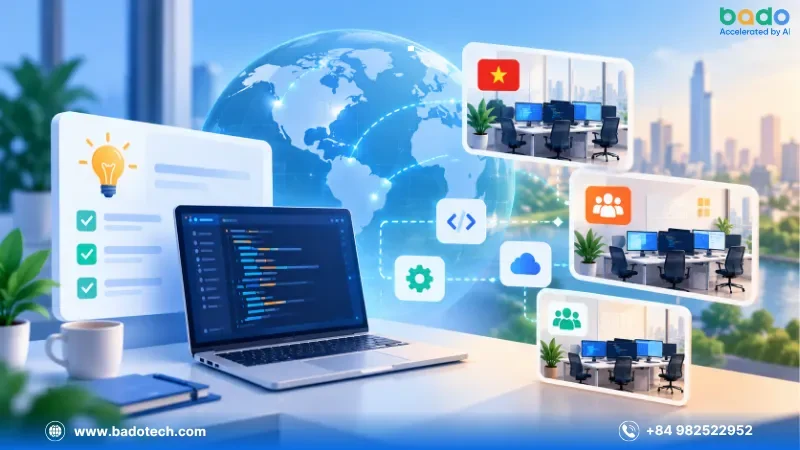
Companies often prefer to concentrate internal resources on product strategy, customer relationships, sales, and operations. By delegating an appropriate development initiative to an external partner, they can reduce the need to manage individual engineering tasks while retaining oversight of business outcomes.
Staff Augmentation vs Outsourcing: Which Model Is Better for Hiring Developers in Vietnam?
Vietnam has become a destination businesses consider when looking for software development talent and external engineering partners. However, choosing a Vietnamese provider does not remove the need to evaluate technical quality, communication, security, and delivery processes.
When deciding whether to hire developers in Vietnam through staff augmentation or software outsourcing, start by identifying the type of support your business actually needs.
Choose Staff Augmentation to Extend Your Team
If your company already has an engineering team and needs additional capacity, staff augmentation can connect you with developers who work within your existing processes.
For example, you may hire software developers with experience in .NET, React, or Flutter to support a product release, implement new features, or address a specific skills gap.
This arrangement is particularly suitable for businesses that want direct access to engineers and prefer to retain control of technical decisions.
Choose Software Outsourcing for End-to-End Delivery
If your company needs a partner to coordinate development activities, outsourcing may be more appropriate. Depending on the engagement, the provider can assemble the necessary team, organize development workflows, conduct quality assurance, and deliver agreed milestones.
This approach can be useful for international businesses that want to access Vietnam's software development expertise without establishing a local engineering operation.
Evaluate the Provider Beyond Cost
When comparing providers, review their experience with your technology stack, communication practices, security controls, documentation standards, and approach to quality assurance. For example, businesses planning enterprise applications may need experienced .NET developers, while mobile product teams may need to hire Flutter developers to support cross-platform development.
The right partner should be able to explain how its team will work with your organization, how progress will be measured, and how technical knowledge will be retained throughout the engagement.
Explore Bado Tech's software development services to learn about options such as IT staff augmentation, dedicated developers, dedicated development teams, product development, and AI engineering.
On the other hand, you can combine staff augmentation and software outsourcing. Businesses do not always need to choose a single model for every development activity. A hybrid approach can help organizations retain control over their core product while delegating selected initiatives to an external delivery partner. This approach allows the company to allocate responsibilities according to project complexity, internal expertise, and business priorities.
However, hybrid arrangements require clear boundaries. Teams should agree on ownership of the codebase, technical architecture, project dependencies, release processes, security responsibilities, and acceptance criteria. Without this coordination, overlapping responsibilities can create duplicated work, inconsistent technical decisions, and delivery delays.
Conclusion
The comparison between staff augmentation vs outsourcing comes down to control, responsibility, and the type of support your business needs. Both models can provide access to software development expertise without requiring you to build every capability in-house.
Before making a decision, assess your technical leadership, project scope, budget, and long-term product strategy. Then choose a provider whose engagement model aligns with your expectations. Bado Tech is considered a trusted partner for software outsourcing services; please contact us to discuss your project.
Frequently Asked Questions
1. Is staff augmentation cheaper than software outsourcing?
Not necessarily. Staff augmentation is often priced per developer or by time worked, while outsourcing may use fixed-price, milestone-based, or time-and-materials pricing. Total cost depends on project complexity, management overhead, delivery efficiency, and the services included.
2. Can I hire developers in Vietnam through both models?
Yes. Businesses can hire developers in Vietnam through staff augmentation to extend an existing team or work with a software outsourcing provider to deliver a defined project. The appropriate model depends on internal management capacity, technical requirements, and delivery expectations.
3. What should I look for in a software development partner?
Evaluate technical expertise, relevant project experience, communication, security practices, code quality, documentation, and pricing transparency. You should also clarify team responsibilities, intellectual property ownership, acceptance criteria, and post-launch support before signing an agreement.