

Software development has become essential for businesses that want to launch digital products, improve operations, and stay competitive. However, building and maintaining an in-house engineering team requires time, budget, and access to the right technical talent. For many companies, software outsourcing offers another way to turn product ideas into working solutions without managing every development role internally.
But what is software outsourcing, how does it work, and when should a business consider it? Understanding the available models, potential benefits, and common challenges can help you make a more informed decision before choosing a development partner.
What Is Software Outsourcing?
Software outsourcing is the practice of hiring an external company or team to handle some or all of a business's software development activities. Instead of relying entirely on internal employees, a company works with an outside provider to build, improve, maintain, or support its software products.
These activities can include custom software development, web and mobile application development, UI/UX design, software testing, system integration, cloud engineering, and ongoing maintenance.
For example, a startup may hire an external development team to build its minimum viable product (MVP) before investing in a permanent engineering department. An established business may outsource a system integration project or bring in experienced developers to support its existing team during a product launch.
The key point is that software outsourcing does not necessarily mean handing over an entire project. Businesses can outsource a specific task, add individual specialists to an internal team, or work with a dedicated development team responsible for a broader product roadmap.
The right arrangement depends on the company's goals, internal capabilities, project complexity, budget, and expected timeline.
How Does Software Outsourcing Work?
Software outsourcing usually begins with a business defining its needs and finding a provider with the appropriate technical skills and delivery capabilities. Although each engagement is different, most follow a similar process.
1. Define the project scope and business goals
Before contacting potential providers, identify the problem the software needs to solve. Outline the target users, essential features, expected outcomes, technical requirements, budget range, and desired launch timeline.
A clear scope helps both parties understand what needs to be delivered. If the product requirements are still evolving, the engagement should allow for discovery, prototyping, and iterative development rather than relying on a fixed specification that may quickly become outdated.
2. Evaluate potential outsourcing partners
Review each provider's technical expertise, relevant project experience, communication practices, development methodology, and approach to quality assurance.
Ask how the team handles project planning, code reviews, testing, documentation, security, and changes in scope. References, case studies, and discussions with the people who will actually work on the project can provide more useful insights than a sales presentation alone.
3. Choose an engagement model
Once a suitable provider has been identified, agree on how the collaboration will operate. This includes team composition, responsibilities, communication channels, working hours, reporting practices, payment terms, and decision-making authority.
The contract should also address intellectual property ownership, confidentiality, access to source code, data protection, and the process for resolving disputes.

4. Develop and test the software
The development team translates requirements into working software through activities such as design, coding, testing, and integration. Depending on the project, work may be organized into Agile sprints, milestone-based phases, or another agreed delivery process.
Regular demonstrations, progress reports, and feedback sessions help the client identify issues early and keep the product aligned with business needs.
5. Launch, maintain, and improve
Software development does not end when the first version is released. The product may require deployment support, bug fixes, performance improvements, security updates, and new features.
Before the engagement begins, establish who is responsible for maintenance, production incidents, technical documentation, and future enhancements. This creates a clearer path from initial development to long-term product growth.
Common Software Outsourcing Models
Software outsourcing can be structured in several ways. Choosing the right services of software outsourcing is important because it affects cost predictability, team flexibility, project control, and the level of ongoing collaboration.
Project-based outsourcing
In project-based outsourcing, the provider agrees to deliver a defined scope of work, often with specific milestones, deliverables, and acceptance criteria. This model may suit businesses with clear requirements and a relatively predictable project scope, such as developing a business website, migrating a system, or implementing a specific integration.
However, major changes to the original requirements can affect the budget and timeline. It is therefore important to define how change requests will be evaluated and approved.
Dedicated development team
A dedicated development team is an external group of specialists assigned to work on a client's product or long-term development needs. The team may include software engineers, QA specialists, UI/UX designers, business analysts, and technical leads.
This model is useful when a company needs ongoing development capacity, expects its product roadmap to evolve, or wants to work closely with a consistent team without recruiting every role internally.
The client typically retains significant input into priorities and product direction, while the provider supports team management and delivery operations according to the agreed arrangement.
Staff augmentation
Staff augmentation involves adding external professionals to an existing in-house team to address specific skill gaps or temporary capacity needs. For example, a company may bring in a senior .NET developer, a Flutter specialist, or a QA engineer to support a critical release. The external professionals work alongside internal employees, usually following the client's established processes.
This approach can be effective when the company already has strong technical leadership and project management but needs additional expertise or faster access to talent.
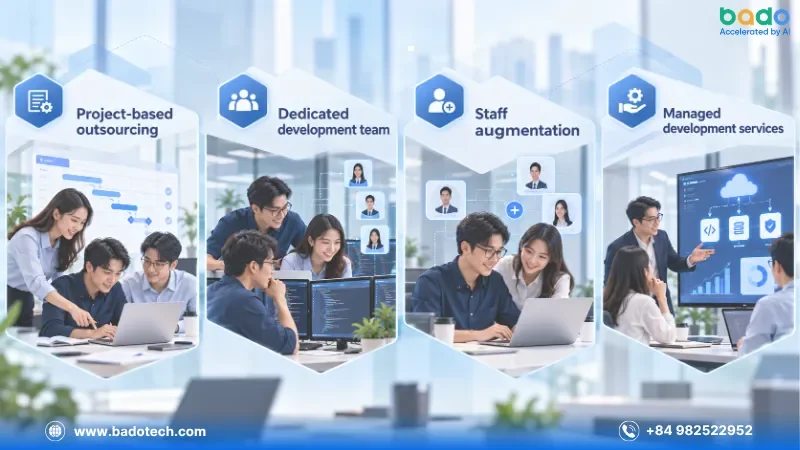
Managed development services
With managed development services, an external provider takes responsibility for an agreed set of technical activities or delivery outcomes. The scope may include application development, maintenance, testing, or management of a particular workstream.
The provider generally has greater responsibility for organizing delivery than in a staff augmentation arrangement. However, the precise division of responsibilities depends on the contract and operating model.
Businesses should evaluate the provider's accountability, reporting structure, service expectations, and escalation procedures before choosing this option.
Onshore, Nearshore, and Offshore Software Outsourcing
Another way to classify outsourcing is by the geographic relationship between the client and the external development team.
Onshore outsourcing means working with a provider in the same country. It can simplify communication and coordination, although the available talent pool and cost structure depend on the local market.
Nearshore outsourcing means working with a provider in a nearby country or region. Depending on the locations involved, this arrangement may offer overlapping working hours, easier travel, and closer cultural or business alignment.
Offshore outsourcing means working with a provider in a more distant country or region. Businesses may gain access to different talent markets, but they need to plan carefully for time-zone differences, communication, and coordination.
These categories are not guarantees of quality or cost savings. A nearby provider may be expensive, while a distant provider may work effectively with the right processes and team structure. For example, a company based in Australia or Singapore may consider a development partner in Vietnam. The practical value of that relationship depends on technical fit, communication, delivery standards, and the ability to work across time zones.
What Are the Benefits of Software Outsourcing?
Software outsourcing can provide several business advantages when the engagement is designed around clear goals and managed effectively.
Access to specialized technical talent
Hiring externally can help businesses access expertise that may be difficult or time-consuming to recruit locally. Depending on the provider, this can include backend and frontend development, mobile engineering, cloud infrastructure, QA automation, data engineering, and AI-related capabilities.
This flexibility is especially useful when a project requires a combination of skills that the internal team does not currently have.
Greater flexibility in team capacity
Business needs change throughout the product lifecycle. A company may need a small team during discovery, more engineers during development, and additional QA capacity before launch.
Outsourcing can make it easier to adjust team composition to project requirements. The actual speed and flexibility depend on resource availability, onboarding requirements, and the terms of the agreement.

Potential cost efficiency
Building an in-house engineering function involves more than salaries. Recruitment, onboarding, employee benefits, equipment, management, and retention can all contribute to the overall cost.
Outsourcing changes how some of these expenses are structured and may reduce the need to recruit permanent employees for every project. However, it does not automatically make software development cheaper.
A meaningful comparison should consider the total cost of delivery, including project management, communication, rework, vendor oversight, and ongoing maintenance.
More focus on core business priorities
Working with an external development team can free internal staff to concentrate on product strategy, customer relationships, sales, and other business-critical activities. This benefit is most likely when responsibilities are clearly divided. Outsourcing does not eliminate the need for internal decision-makers; the client still needs to provide direction, prioritize requirements, and evaluate business outcomes.
Support for faster product delivery
An established provider may already have experienced developers, delivery processes, and quality assurance practices in place. This can reduce some of the time required to recruit and organize a team from scratch. However, faster delivery is not guaranteed. Unclear requirements, slow feedback, integration problems, and poor coordination can delay an outsourced project just as they can an internal one.
Final Thoughts
Software outsourcing is more than hiring external developers. It is a way to organize software delivery by combining a company's business knowledge with an external team's technical capabilities. The outcome depends on choosing the right engagement model, setting clear expectations, maintaining communication, and managing quality, security, and ownership from the beginning. A well-structured partnership can help a business build software more flexibly while keeping its internal team focused on strategic priorities.
For companies exploring external development support, Bado Tech works with businesses seeking software development capabilities across markets including Vietnam, Singapore, Australia, Hong Kong, Japan, and the Nordic countries. The next step is to define your product goals, identify the expertise you need, and evaluate whether an external development partnership fits your plans. Contact us today for a consultation on your project.
Frequently Asked Questions
1. What is software outsourcing in simple terms?
Software outsourcing means hiring an external company or team to develop, maintain, test, or support software instead of handling all the work internally.
2. What is the difference between software outsourcing and in-house development?
In-house development relies on employees within the organization, while outsourcing involves working with an external provider. In-house teams offer direct organizational control, whereas outsourcing can provide access to external expertise and flexible team capacity.
3. What are the main types of software outsourcing?
Common engagement models include project-based outsourcing, dedicated development teams, staff augmentation, and managed development services. Geographic models include onshore, nearshore, and offshore outsourcing.
4. Is software outsourcing cheaper than hiring an in-house team?
It can be, but not in every case. The total cost depends on project complexity, team experience, provider rates, management overhead, recruitment needs, quality, and long-term maintenance.
5. How do I choose a reliable software outsourcing company?
Evaluate technical expertise, relevant experience, communication, delivery processes, security practices, contractual terms, and total cost. Clear expectations and a well-defined initial scope can also help reduce risk.