

Software outsourcing can help businesses access technical expertise, scale development capacity, and accelerate product delivery. However, communication gaps, security vulnerabilities, budget overruns, and poor project management can put business outcomes at risk. Learn how to identify common software outsourcing risks, establish effective safeguards, and choose a development partner that supports your long-term goals.
What Are the Main Software Outsourcing Risks?
Software outsourcing enables businesses to work with external development teams instead of building every technical capability internally. This approach can provide access to specialized expertise, increase development capacity, and help companies respond to changing market demands without committing to a permanent in-house team for every role.
However, outsourcing also introduces risks that can affect project performance, product quality, and long-term business value. These challenges do not necessarily result from a provider's lack of technical ability. They can also arise from unclear requirements, weak governance, unrealistic expectations, or a mismatch between the engagement model and the project's needs.
Understanding software outsourcing risks before starting a project helps businesses establish appropriate controls and make better decisions throughout the development lifecycle.
Communication Gaps and Misaligned Expectations
Communication is one of the most common challenges in outsourced software development. Differences in language, time zones, business culture, and technical understanding can prevent clients and developers from sharing the same expectations.
For example, a business may request a feature based on a general description without defining its functionality, user scenarios, or acceptance criteria. Developers may interpret the requirement differently and build a solution that technically works but does not meet the intended business objective. Resolving these misunderstandings after implementation can increase rework and delay delivery.
To reduce this risk, businesses should document requirements, assign clear points of contact, and establish regular communication routines. Shared project management tools, written meeting summaries, and frequent demonstrations of working software help ensure that both parties remain aligned.
Poor Code Quality and Technical Debt
Fast delivery does not always mean good software. A product may appear functional during a demonstration while containing architectural weaknesses, insufficient test coverage, performance issues, or poorly maintained code.
These problems can become more expensive over time as new features depend on existing components. Businesses may eventually spend more on debugging and maintenance than on developing new capabilities.
When evaluating software development services, businesses should examine how the provider manages quality throughout the development process. Important practices include coding standards, peer reviews, automated testing, security checks, and technical documentation.
Quality should be assessed against agreed acceptance criteria rather than subjective impressions. Regular code reviews and testing help identify defects early, when they are generally easier to correct.
Data Security and Intellectual Property Risks
External developers may need access to source code, internal systems, customer information, or confidential business processes. Without suitable controls, this access can create risks involving unauthorized disclosure, data breaches, or disputes over intellectual property ownership.
These concerns are especially important for businesses that handle sensitive information, operate in regulated industries, or develop proprietary software that provides a competitive advantage.
Businesses should establish confidentiality and intellectual property agreements before sharing sensitive materials. Access should follow the principle of least privilege, granting each team member only the permissions necessary for their responsibilities. Secure repositories, multi-factor authentication, access logs, and appropriate data-handling procedures provide additional protection.
Contracts should clearly define ownership of newly developed code, designs, documentation, and other deliverables. They should also distinguish newly created assets from pre-existing intellectual property and clarify responsibilities for protecting confidential information.
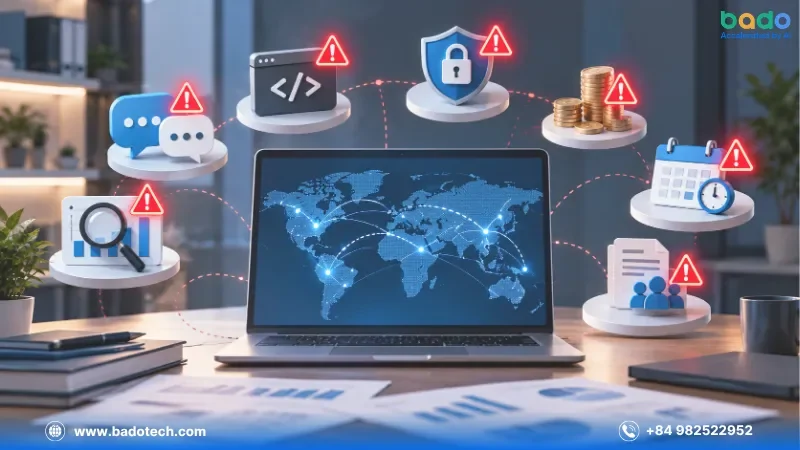
Hidden Costs and Budget Overruns
An attractive hourly rate or monthly development fee does not automatically translate into a lower total project cost. Budgets can increase when requirements change, initial estimates exclude essential activities, or responsibilities for testing, infrastructure, and maintenance are unclear.
Additional expenses may include project management, third-party services, software licenses, deployment, ongoing support, and knowledge transfer. Repeated revisions caused by unclear requirements can also increase the total investment.
Businesses should define project scope, deliverables, assumptions, and exclusions before development begins. They should also agree on pricing arrangements, approval procedures for additional work, and a process for reviewing actual spending against the budget.
When comparing engagement options, dedicated team cost should be assessed in relation to team composition, developer seniority, engagement duration, management requirements, and expected deliverables. Evaluating the full cost of ownership provides a more useful basis for comparison than focusing exclusively on developer rates.
Delivery Delays and Limited Project Visibility
Outsourced projects may fall behind schedule because of unrealistic estimates, changing priorities, delayed approvals, staffing changes, or dependencies on third-party systems. These delays can affect product launches, marketing campaigns, customer commitments, and revenue plans.
Limited visibility can make the situation worse. If stakeholders receive inconsistent reports or cannot review working software regularly, they may discover problems only when a milestone is missed.
Businesses can reduce these risks by dividing work into manageable milestones, identifying dependencies early, and agreeing on realistic delivery expectations. Regular demonstrations and progress reviews should focus on completed deliverables, unresolved blockers, and the next actions required.
A shared backlog and project tracker also help clients understand how development priorities change over time. This creates transparency without requiring unnecessary meetings or excessive administrative reporting.
Vendor Dependency and Knowledge Loss
Long-term outsourcing can create dependency when the external provider holds most of the knowledge about the software architecture, deployment process, or business logic.
If key developers leave, the provider changes its team, or the business decides to work with another vendor, missing documentation and restricted access can make the transition difficult. The resulting disruption may affect maintenance, product continuity, and future development.
To prevent this situation, businesses should retain access to essential project assets and require documentation as part of ongoing delivery. Deployment procedures, system architecture, integration details, and maintenance instructions should be documented and updated when significant changes occur.
Contracts should also address knowledge transfer, transition assistance, and access to source code when the engagement ends. These safeguards help preserve business continuity regardless of whether the company continues working with the same provider.
Evaluate Software Outsourcing Partners and Choose the Right Model
Selecting a vendor is only the beginning. Effective software outsourcing depends on how both parties manage the project, communicate decisions, control risks, and measure progress. A structured collaboration process helps prevent misunderstandings and keeps development focused on business outcomes.
Establish Clear Communication and Project Governance
Identifying risks is only the first step. Businesses must also determine whether a potential provider has the technical expertise, delivery processes, and working approach needed to manage those risks effectively.
If you are researching how to outsource software development, vendor selection should involve more than comparing proposals and hourly rates. A structured evaluation helps reveal how providers handle uncertainty, maintain quality, and work with clients throughout the project.
Evaluate Technical Expertise and Relevant Experience
Start by reviewing the provider's experience with comparable products, technical architectures, integrations, and business requirements. Relevant experience does not guarantee success, but it can help establish whether the team understands the project's complexity.
Ask how the provider approaches architecture, testing, code reviews, security, deployment, and ongoing maintenance. A reliable partner should be able to explain its development process clearly and identify potential technical challenges before implementation begins.
Businesses planning to hire developers should also assess the specific skills and experience required for the project. The team should have an appropriate balance of technical expertise, problem-solving ability, and communication skills rather than relying on job titles alone.
Define Scope, Responsibilities, and Performance Expectations
Unclear responsibilities can create friction even when both parties have strong technical capabilities. The client may assume that the provider manages product decisions, while the provider expects the client to supply detailed requirements and approve every significant change.
Before signing a contract, clarify who owns the product roadmap, approves requirements, manages technical decisions, and accepts completed deliverables. Define how changes will be assessed, estimated, approved, and documented.
Performance expectations should also be measurable. Depending on the project, relevant indicators may include milestone completion, defect resolution, test coverage, release stability, and adherence to agreed acceptance criteria.
These indicators should support better decisions rather than encourage teams to optimize for task counts at the expense of product quality.
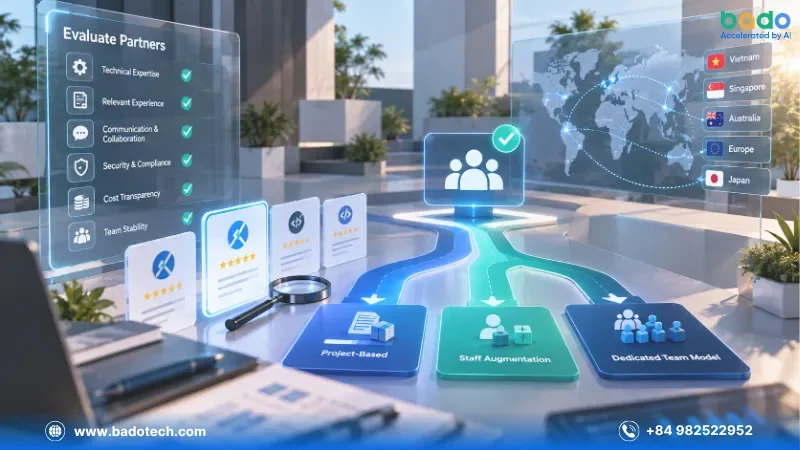
Review Security, Contracts, and Exit Arrangements
A suitable outsourcing agreement should address confidentiality, intellectual property ownership, payment terms, liability, termination, and responsibilities for data protection.
Businesses should also understand whether subcontracting is permitted, how access to internal systems is managed, and what happens to project assets when the engagement ends. For products involving regulated data, legal and security specialists may need to review the proposed arrangements.
Exit planning is particularly important for long-term engagements. The contract should establish how source code, credentials, documentation, and other relevant assets will be transferred when necessary.
These provisions do not indicate a lack of trust in the provider. Instead, they establish clear expectations and reduce uncertainty for both parties.
Choose an Engagement Model That Fits Your Project
Different outsourcing models provide different levels of flexibility, control, and responsibility. Choosing the right structure helps businesses allocate resources according to their product requirements.
A project-based arrangement can work well when scope and deliverables are clearly defined. Staff augmentation can help an existing engineering team fill specific skill gaps while retaining internal technical leadership. A dedicated team can be more suitable when a business needs consistent development capacity and ongoing collaboration.
The dedicated team model typically involves a group of developers and, depending on the engagement, other specialists who focus on the client's product over an agreed period. It can support evolving requirements and long-term development, but the client still needs clear priorities, product ownership, and an effective decision-making process.
When comparing models, businesses should consider team continuity, expected duration, communication requirements, management responsibilities, and total engagement cost. The right choice depends on the project's maturity, complexity, and expected pace of change.
Consider Vietnam as a Software Outsourcing Destination
Vietnam is an option for businesses seeking external software development capabilities and access to technical talent. However, choosing a provider in a particular country does not automatically resolve challenges involving quality, security, communication, or delivery.
A practical software outsourcing Vietnam guide should therefore examine more than pricing. Businesses should evaluate technical capabilities, English communication, working-hour overlap, security practices, intellectual property terms, and the provider's ability to maintain team continuity.
It is also useful to understand how the provider manages collaboration across locations. Shared documentation, clear communication routines, and transparent delivery processes can reduce the operational friction associated with offshore development.
Ultimately, the objective is to find a partner whose working approach matches the business's requirements, not simply the provider offering the lowest rate.
How to Mitigate Software Outsourcing Risks With Bado Tech
Effective risk management requires consistent attention before, during, and after development. Businesses need a partner that understands technical requirements, communicates clearly, and supports a delivery process that remains transparent as the product evolves.
Build a Risk Management Process From the Start
Before development begins, establish a shared understanding of project scope, technical requirements, business priorities, responsibilities, and expected outcomes. Identify the risks most likely to affect the project and agree on how they will be monitored.
During development, review progress regularly and maintain visibility into quality, spending, and unresolved issues. When requirements change, assess the effect on the timeline, budget, and technical architecture before approving the change.
After delivery, ensure that the business retains access to source code, documentation, deployment procedures, and other essential assets. This approach supports continuity and makes future maintenance easier, whether the product remains with the same team or moves to another provider.
Risk management should be proportionate to the project. A small application may require relatively lightweight controls, while a complex platform involving sensitive data or multiple integrations may need more extensive security reviews, testing, and governance.
Bado Tech: A Software Development and Outsourcing Partner
Bado Tech is a Vietnam-based technology company focused on software development and outsourcing for businesses that need to build, improve, and scale digital products. Its work spans software development capabilities, product engineering, and dedicated development resources for different business and technical requirements.
The company positions its approach around combining human expertise with AI-supported development workflows. This approach is intended to help development teams work more efficiently while keeping technical judgment, collaboration, and business requirements central to product decisions.
For international businesses, working with a technology partner involves more than gaining access to developers. It also requires a clear understanding of project objectives, an agreed delivery process, and communication practices that allow stakeholders to stay involved throughout development.
Businesses evaluating Bado Tech can explore its services and discuss the appropriate engagement structure based on their project scope, technical requirements, and development goals.
Reduce Delivery Uncertainty With Bado Tech's Dedicated Development Team
For businesses that need ongoing development capacity, Bado Tech's Dedicated Development Team service provides an option to work with a team aligned with the project's requirements and priorities.
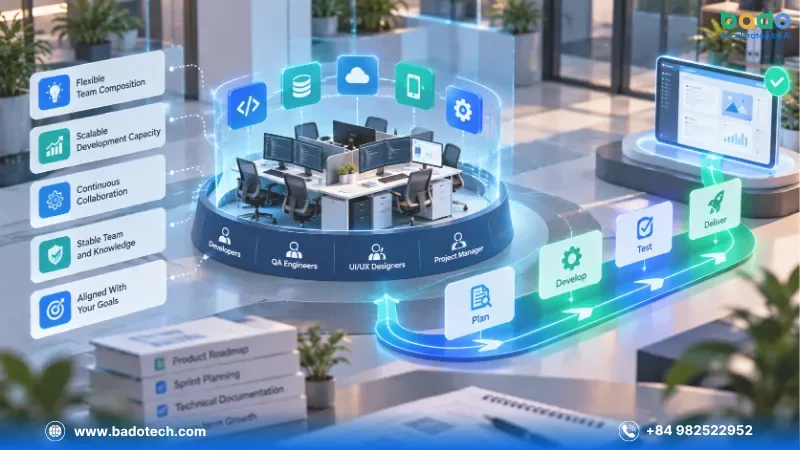
Rather than treating each feature as an isolated delivery, a dedicated team can support continuous development and help maintain knowledge of the product's architecture, business logic, and technical roadmap. This can be particularly useful for companies building a new platform, extending an existing application, or managing a product with evolving requirements.
The effectiveness of this model still depends on clear responsibilities and active collaboration. Before starting an engagement, businesses should agree on team composition, communication routines, development milestones, quality expectations, and the process for adjusting priorities.
The financial side also deserves careful consideration. Evaluating dedicated team cost alongside expected outcomes, team continuity, and management requirements helps businesses determine whether the model offers suitable long-term value.
Bado Tech's dedicated team approach can be discussed according to the needs of each project, allowing businesses to explore a development arrangement that aligns with their technical objectives and operational requirements. Contact us to discuss your requirements, explore suitable engagement options, and identify the development approach that fits your business goals.
Conclusion
Software outsourcing risks should not automatically discourage businesses from working with external development teams. Instead, they should inform how companies evaluate providers, structure agreements, and manage delivery throughout the software lifecycle.
Bado Tech offers software development and outsourcing capabilities for businesses exploring ways to build and scale digital products. For organizations considering a dedicated development team or another outsourcing arrangement, discussing the project requirements early can help establish realistic expectations and a more suitable engagement structure.
Frequently Asked Questions
1. What are the biggest software outsourcing risks?
The main risks include communication gaps, poor code quality, cybersecurity vulnerabilities, intellectual property disputes, budget overruns, delivery delays, limited project visibility, and dependency on an external provider. Their impact depends on the project's complexity and the effectiveness of the controls in place.
2. How can businesses reduce software outsourcing risks?
Businesses should evaluate technical expertise, document requirements, establish clear contractual responsibilities, implement appropriate security controls, and monitor delivery through regular reviews. Retaining access to source code and technical documentation also helps reduce long-term dependency.
3. What should businesses consider when outsourcing software development to Vietnam?
Businesses should assess technical expertise, communication practices, working-hour overlap, security controls, intellectual property protection, pricing transparency, and team continuity. They should also confirm how the provider handles project management, quality assurance, documentation, and ongoing support before committing to an engagement.