

Hiring a dedicated development team gives businesses access to a group of software professionals who focus on their product over an agreed period. For companies expanding their engineering capacity, building a new digital product, or modernizing existing systems, this model can offer more continuity than hiring individual contractors for short-term tasks.
A quote for a dedicated team may cover only engineering resources, or it may include project management, quality assurance (QA), DevOps, recruitment, and other delivery services. Two providers offering similar rates can therefore deliver very different levels of support.
Location also matters, but the lowest-priced market is not automatically the most cost-effective choice. Communication, technical expertise, delivery processes, and the ability to maintain product quality all influence the total investment.
This guide examines the main dedicated team pricing models, the factors that shape your budget, and the differences between outsourcing regions. It also explains how to evaluate quotations and plan a sustainable software development budget.
1. What Are the Different Dedicated Team Cost and Pricing Models?
A dedicated development team is typically a long-term arrangement in which a group of professionals works primarily or exclusively on one client's product. The commercial agreement can take several forms, depending on how much flexibility, budget predictability, and delivery responsibility the client needs.
1.1. Monthly Retainer Pricing
A monthly retainer is one of the most common arrangements for a dedicated development team. The client pays an agreed monthly fee for a defined team composition, capacity, and set of responsibilities.
For example, a team might include a technical lead, three software engineers, one QA engineer, and a part-time delivery manager. The monthly fee depends on each person's seniority, allocation, and the services covered by the agreement.
This model works well for long-term product development, SaaS platforms, and projects with evolving requirements. It makes recurring expenditure easier to forecast and allows the team to accumulate product knowledge over time. The main consideration is utilization. If the client cannot provide clear priorities, timely feedback, or sufficient work, the team may remain underused even though the monthly fee stays the same.
1.2. Hourly or Time and Materials Pricing
Under a Time and Materials (T&M) model, the client pays for the actual hours worked at agreed rates. The final cost changes according to the number of hours consumed, the roles involved, and the work completed.
This approach is useful when requirements are still evolving or when a company needs flexibility to adjust priorities during development. It can also support phased discovery, prototyping, and gradual product expansion.
However, a lower initial estimate does not guarantee a lower final bill. Unclear requirements, additional revisions, unexpected integrations, and poor estimation can increase the total expenditure. To control costs, businesses should agree on hourly rates by role, define approval procedures for additional work, and review actual effort against the budget regularly.
1.3. Fixed-Price Contracts
A fixed-price contract establishes an agreed fee for a defined scope of work and a set of deliverables. It is generally more suitable when requirements, acceptance criteria, and implementation expectations are sufficiently clear.
For example, a company may outsource a specific integration or a clearly scoped application module under a fixed-price agreement.
The advantage is greater budget certainty for the agreed scope. The trade-off is reduced flexibility: substantial changes may require a formal change request, additional fees, or revised delivery dates. Fixed pricing should not be confused with a traditional dedicated team arrangement. A fixed-price project primarily purchases defined outcomes, while a dedicated team arrangement purchases sustained engineering capacity.
>> View more: Dedicated Team Model: Costs, Risks, and How to Choose the Right Engagement
1.4. Hybrid Pricing
A hybrid model combines elements of monthly retainers, T&M, and fixed-price contracts. A business might retain a dedicated core team on a monthly basis while using fixed-price agreements for clearly defined modules or additional hourly capacity for specialized tasks.
This arrangement can work well when a product has a stable development roadmap but occasionally requires extra expertise. It also allows companies to maintain continuity without committing every workstream to the same commercial structure.
Before choosing a model, compare not only the headline price but also the degree of flexibility, the client's management responsibilities, and the financial consequences of changing scope.
2. What Factors Affect Dedicated Team Cost?
The total cost of a dedicated development team is determined by several interconnected variables. Understanding these factors helps businesses evaluate quotations more accurately and identify opportunities to reduce spending without weakening delivery quality.
2.1. Team Size and Role Composition
The number of people on a team is an obvious cost driver, but the mix of roles is equally important. A small product team may require only a technical lead and a few engineers if the client already has product management, design, and QA capabilities in-house. A more independent team may also need a business analyst, UI/UX designer, QA specialist, DevOps engineer, and delivery manager.
Each additional role increases the budget, but removing a role does not always reduce the total cost of delivery. For example, excluding QA may lower the monthly quotation while increasing the risk of defects, rework, and delayed releases.
Businesses should therefore build a team around the work that needs to be delivered rather than selecting a team size based on price alone.
2.2. Developer Seniority and Experience
Developer seniority has a direct impact on outsourcing rates. Junior developers generally cost less per hour than senior engineers or technical leads, while specialized architects and engineering managers may command higher rates.
Routine implementation tasks may be handled effectively by mid-level engineers under appropriate technical guidance. Complex architecture decisions, legacy modernization, performance optimization, and security-sensitive work may require more experienced specialists.
A balanced team often combines senior technical leadership with mid-level implementation capacity and appropriate QA coverage. This approach helps align labor costs with the difficulty and risk of each task.

2.3. Outsourcing Location
Geography affects labor costs, the availability of technical talent, and the commercial rates charged by outsourcing providers.
North American and Western European providers generally occupy higher price brackets than many offshore destinations. South and Southeast Asia can offer lower rates, while Latin America may appeal to businesses that prioritize overlapping working hours with North American teams.
Nevertheless, regional comparisons should account for the type of data being compared. Developer salaries, freelancer rates, and agency billing rates are not interchangeable.
When evaluating a market such as Vietnam, consider the provider's actual rates, engineering experience, English communication, time-zone overlap, and ability to retain the team throughout the engagement.
2.4. Technical Complexity and Technology Stack
Project complexity can increase the cost of a dedicated development team by requiring more specialized skills, additional engineering time, and stronger quality controls.
A conventional business application may need a relatively standard web development team. A product involving AI integration, real-time processing, complex data pipelines, legacy system migration, or high-availability architecture may require specialists and additional infrastructure.
The programming language alone does not necessarily determine the price. Clutch's 2026 pricing guide reports similar listed hourly ranges across several common technologies, including .NET, Java, and Flutter. This suggests that provider experience, project requirements, and delivery scope should be assessed alongside the technology stack. Businesses should specify the technical requirements, integration dependencies, performance targets, and security expectations before requesting a quotation.
2.5. Project Duration and Team Stability
The duration of an engagement affects the overall financial commitment and the value obtained from the team.
Longer engagements may allow teams to develop a deeper understanding of the product, reduce repeated onboarding, and establish more efficient delivery processes. However, a long-term commitment is only beneficial when the business has a sufficiently clear roadmap and a continuing need for the team's capacity.
Short engagements can be appropriate for specific technical objectives, but setup and knowledge-transfer activities may represent a larger proportion of the total effort. When comparing providers, clarify minimum contract periods, notice requirements, replacement policies, ramp-up arrangements, and the process for scaling the team up or down.
2.6. Project Management, QA, and Additional Services
A dedicated team quotation may include different levels of delivery support. Some providers supply engineers who work under the client's management, while others provide a more comprehensive service with technical leadership, delivery coordination, QA, and infrastructure support.
These differences can materially affect pricing. Before signing a contract, confirm whether the following services are included:
- Project or delivery management.
- Business analysis and requirements documentation.
- Manual and automated quality assurance.
- UI/UX design and product discovery.
- DevOps, cloud infrastructure, and CI/CD.
- Security testing, compliance support, and documentation.
- Onboarding, knowledge transfer, and ongoing reporting.
A transparent quotation should identify which services are included, which are optional, and which remain the client's responsibility.
2.7. Hidden Costs and Operational Overhead
The monthly team fee is not always the full cost of an outsourcing engagement.
Businesses may also need to budget for cloud hosting, software licenses, development environments, monitoring tools, security reviews, and internal time spent coordinating the external team. Onboarding and knowledge transfer can also require meaningful effort from both sides.
Another important consideration is rework. If requirements are unclear or feedback arrives late, developers may spend time revising work that was already completed. This increases effective expenditure without necessarily producing additional business value.
A practical budget should therefore include the contracted team fee, client-side operating costs, any optional services, and a contingency appropriate to the project's uncertainty.
3. Dedicated Team Cost by Region, Role, and Team Size
Comparing dedicated team cost requires more than looking at a single hourly rate. A junior developer in Vietnam, a senior engineer in Poland, and a technical lead in the United States perform different roles and come with different levels of experience and delivery responsibility.
For businesses evaluating software outsourcing, the most useful approach is to compare rates by role, estimate monthly expenditure, and calculate the total cost of a team with a defined composition.
The following tables use published provider pricing guides and industry benchmarks available in 2026. All figures are indicative estimates in USD, not guaranteed quotations. Actual prices vary according to technical specialization, vendor service coverage, location within a country, and contract terms.
3.1. Dedicated Development Team Cost by Role and Region
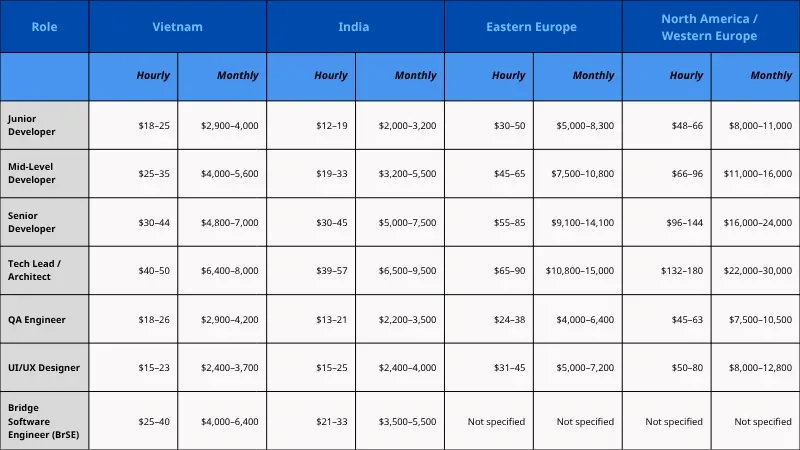
Source: VNEXT — Dedicated Development Team Cost 2026.
The monthly rates above are reproduced from the provider's published guide. Hourly and monthly figures are not perfectly interchangeable: for example, a monthly rate of $4,800 divided by 160 hours equals $30 per hour, while a monthly rate of $7,000 divided by 160 hours equals $43.75 per hour. Small differences may result from rounding.
These figures represent VNEXT's published estimates rather than independently verified market-wide averages. The regional categories are also broad: Eastern Europe includes markets with different labor costs, while North America and Western Europe combine several high-cost markets.
Vietnam offers a range of options for companies that need a combination of engineering capacity and long-term product support. In the table, mid-level developers are priced at $25-35 per hour, while senior developers are listed at $30-44 per hour.
India has lower listed rates for several roles, especially junior developers and QA engineers. However, rates vary significantly among providers, cities, and specialist skill sets. Businesses should evaluate technical capability and delivery processes rather than assuming that every team in a lower-priced market offers equivalent services.
Eastern Europe can be attractive for companies that need particular technical expertise or closer collaboration with European stakeholders. North America and Western Europe generally sit in higher price brackets, which may be appropriate when local presence, communication requirements, or specialized engineering capabilities justify the additional cost.
The key is to compare equivalent roles, experience levels, and service coverage. A senior developer rate should not be compared directly with a blended rate covering junior developers, QA, and project management.
>> View more: Why Outsource Software Development to Vietnam
3.2. Cross-Checking Rates with Other 2026 Industry Sources
DECODE's 2026 offshore software development rate guide reports indicative hourly ranges for mid-to-senior professionals across several countries. Its estimates include software engineers, solution architects, UI/UX designers, and project managers.
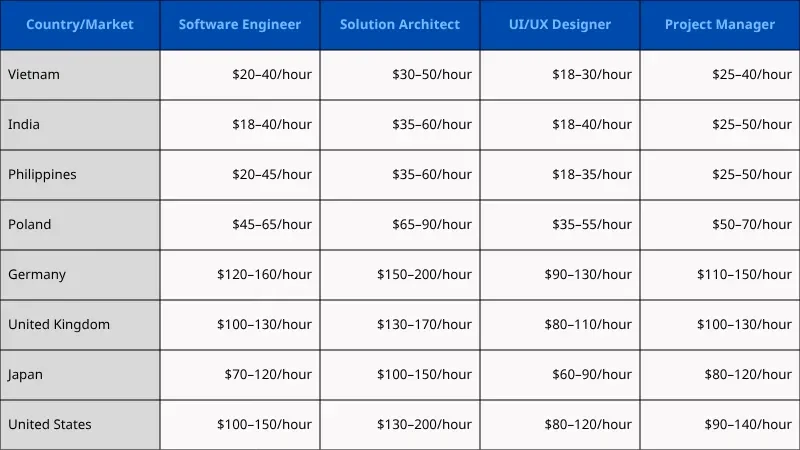
Source: DECODE — Offshore Software Development Rates: 2026 Guide.
A software engineer in Vietnam or India may be available at a lower published rate than a comparable professional in Germany, the United Kingdom, or the United States. However, the financial advantage of outsourcing depends on the actual service delivered, not the country name alone.
For example, a solution architect may be priced substantially above a software engineer because the role involves system design, technical decision-making, and responsibility for architectural risks. Similarly, project management and UI/UX design should be budgeted separately when they are not included in the provider's engineering rate.
3.3. Dedicated Development Team Cost by Team Size
Role-level pricing helps estimate the cost of individual resources, but businesses usually need to know the monthly investment required for a complete team. The following examples use three team configurations published by VNEXT. They illustrate how monthly budgets change as the team grows.
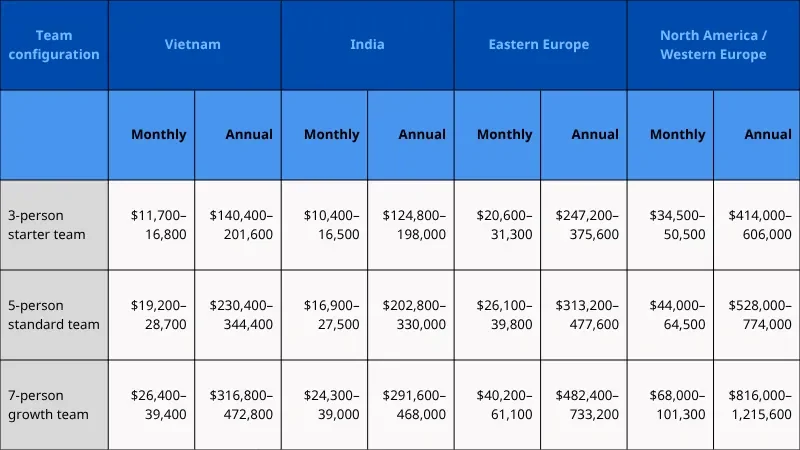
Source: VNEXT — Dedicated Development Team Cost 2026.
The team structures used in the source are:
- 3-person starter team: One senior developer, one mid-level developer, and one QA engineer. Suitable for early product development, MVP validation, or a clearly scoped set of features.
- 5-person standard team: One project manager, one senior developer, one QA engineer, one BrSE, and one mid-level developer. Designed for more structured delivery and closer coordination with client stakeholders.
- 7-person growth team: One project manager, two senior developers, one mid-level developer, one BrSE, one QA engineer, and one UI/UX designer. Suitable for products with several parallel workstreams and growing design and testing requirements.
These examples are useful for initial budgeting, but they are not universal market prices. In particular, the 5-person team includes a BrSE, a role that may not be necessary for every international client. Businesses should remove or replace roles that do not match their delivery needs and request a revised quotation.
Annual figures also assume the team remains at the stated monthly cost for 12 months. They do not account for rate changes, taxes, exchange-rate movements, additional services, or changes in team composition.
It provides an additional reference when building a team budget, particularly when the project requires frontend, backend, DevOps, and QA capabilities. The final monthly cost depends on how many people are required, the number of billable hours, whether the team includes management and technical leadership, and which operational services are included.
For example, a five-person team with a blended rate of $30 per hour and 160 billable hours per person per month would cost: 5 × 160 × $30 = $24,000 per month.
This calculation is illustrative. It is not a published average or a guaranteed price for a Vietnam-based team. The blended rate must reflect the actual mix of roles, and the estimate excludes any additional costs not covered by the agreed rate.
3.5. What About Australia, Singapore, Northern Europe, and Hong Kong?
Businesses targeting these markets should distinguish between the cost of hiring a local development company and the cost of engaging an offshore team that serves clients in that market.
Clutch's 2026 pricing guide reports that software development companies listed in Australia commonly charge $100-149 per hour. Canada is listed in the same band, while companies in the United States are listed at $50-99 per hour. These are provider-level price bands and do not isolate dedicated-team roles or seniority.
For Singapore, a 2025 pricing guide from TechDirectory reports indicative hourly ranges of S$120-220 for senior engineers at boutique Singapore-based agencies, S$70-150 for blended regional delivery firms, and S$200-350 or more for large enterprise integrators.
For Northern Europe and Hong Kong, comparable role-by-role dedicated-team pricing should be obtained from providers serving those markets. A regional label alone is not sufficient evidence for assigning a specific hourly rate.
3.6. How to Use These Benchmarks When Preparing a Budget
The figures above are best used as a starting point for planning rather than as a substitute for a provider quotation.
Before comparing two dedicated development team proposals, confirm that both include equivalent roles, seniority levels, monthly capacity, management responsibilities, QA coverage, and operational services. A quotation that excludes QA or project management may appear cheaper even when it does not provide the same delivery capacity.
It is also important to distinguish employee salaries from outsourcing rates. A software development provider's billing rate may cover recruitment, employment costs, infrastructure, delivery management, and business operations in addition to the engineer's compensation.
Finally, estimate the budget using the actual team composition and agreed working capacity. Add separately priced services and contingency where appropriate, but avoid counting costs that are already included in the provider's monthly fee.
A transparent, role-based quotation makes it easier to compare Vietnam with India, Eastern Europe, or a local delivery provider in Australia or Europe. More importantly, it helps businesses select a team that fits both their budget and their product's technical requirements.
Conclusion
Dedicated team cost is shaped by more than the hourly rate of individual developers. Team composition, seniority, outsourcing location, technical complexity, management support, and contract structure all influence the total investment.
Regional benchmarks can help businesses shortlist potential outsourcing destinations, but they should not replace a role-by-role quotation. In particular, broad Asian pricing data should not be treated as a precise benchmark for Vietnam.
For businesses planning long-term product development, the most useful comparison is the total cost of obtaining the required engineering capacity and delivery support. A well-structured dedicated development team can provide continuity, flexibility, and predictable recurring expenditure when its composition and operating model match the project's needs.
BadoTech helps businesses evaluate software development requirements and build teams around their technical and delivery goals. If you are planning to expand your engineering capacity, explore BadoTech's software development services to discuss an engagement model that fits your roadmap.
Frequently Asked Questions
1. Is a dedicated development team cheaper than an in-house team?
It can reduce the need to recruit and administer a full internal engineering team, but the financial outcome depends on the provider's fees, the services included, and the client's management requirements. Compare total operating costs rather than salaries alone.
2. What is usually included in dedicated team pricing?
Pricing may cover software engineers, basic coordination, and certain administrative services. QA, UX/UI design, DevOps, security work, infrastructure, and product management may be included or billed separately, depending on the provider.
3. How can businesses reduce dedicated team cost?
Businesses can optimize spending by choosing the right seniority mix, defining requirements clearly, avoiding unnecessary roles, maintaining a stable roadmap, and monitoring quality and delivery performance. Comparing transparent, like-for-like quotations is also essential.