

Choosing a software outsourcing model determines how a business allocates its development budget, manages delivery risks, retains control over priorities, and responds to changing market demands.
The dedicated team model is one option for companies that need sustained engineering capacity without hiring every specialist in-house.
This guide examines the dedicated team model from a business and outsourcing perspective, helping decision-makers evaluate whether it fits their operating model and how to structure a more effective engagement.
What Is the Dedicated Team Model in Software Outsourcing?
The dedicated team model is a long-term software outsourcing arrangement in which a service provider allocates development resources to a client's product or business objectives under agreed engagement terms.
Unlike a conventional project-based contract, where the primary focus is a defined scope and deliverables, this model provides ongoing development capacity. The client typically retains substantial influence over priorities, while the provider supplies the agreed resources and operational support.
The distinction matters because software products rarely remain static. Requirements, customer expectations, and technical priorities can change throughout the development lifecycle. An engagement designed for continuity can accommodate these changes more naturally than a contract built around a fixed set of deliverables.
Nevertheless, a dedicated team is not automatically the right choice for every company. Its value depends on whether the business has enough ongoing work to justify a sustained commitment and whether it can provide clear priorities for the engagement.
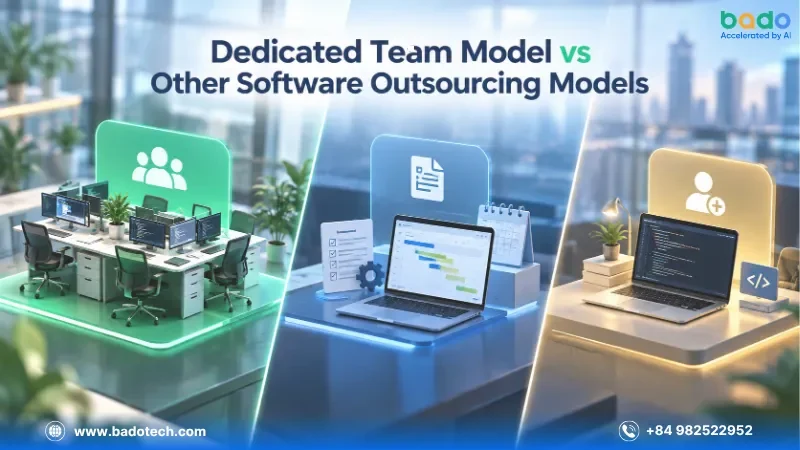
Dedicated Team Model vs Other Software Outsourcing Models
Different software outsourcing models address different business needs. Before choosing one, companies should identify whether they need additional individual specialists, continuous development capacity, or a provider responsible for delivering a defined outcome.
Comparing the Main Engagement Models
Actual arrangements vary by contract. The labels alone do not determine who controls delivery, accepts risks, or manages individual contributors.
Staff Augmentation vs Outsourcing: What Is the Real Difference?
The comparison between staff augmentation vs outsourcing often becomes confusing because outsourcing is an umbrella term covering several engagement structures.
Staff augmentation typically adds external specialists to an existing team. The client generally supplies technical leadership, assigns work, and integrates those specialists into established processes.
A dedicated team offers a more sustained arrangement around a shared development objective. Depending on the agreement, the provider may coordinate the team while the client sets product priorities and makes business decisions.
Project-based outsourcing places greater emphasis on delivering a specified scope. It can work well when acceptance criteria are clear and the client wants the provider to take responsibility for an agreed outcome.
When Does the Dedicated Team Model Make Business Sense?
A dedicated engagement is most suitable when development demand is recurring and the business expects to continue investing in its product over an extended period.
Consider a Dedicated Team When
- Your product roadmap includes multiple releases, ongoing enhancements, and maintenance
- Your internal team cannot consistently meet development demand
- Your requirements evolve too frequently for a rigid, fixed-scope contract
- You need several complementary technical capabilities over time
- You want to retain product decision-making while accessing external engineering resources
For example, a SaaS company expanding into new markets may need to maintain its existing platform while introducing new integrations, improving performance, and developing additional features. A continuing engagement can provide a consistent source of development capacity for these parallel priorities.
When Another Model May Be More Appropriate
A dedicated team may be less suitable when the project has a short timeline, limited ongoing work, or clearly defined deliverables that will not change significantly.
In these cases, project-based outsourcing may offer a simpler commercial structure. Staff augmentation may be more appropriate when the company already has strong technical leadership and needs only one or two additional specialists.
Businesses should also consider whether they can assign a product owner, approve requirements, and provide feedback consistently. Without these inputs, even a technically capable team may struggle to make meaningful progress.
How Much Does the Dedicated Team Model Cost?
There is no universal price for a dedicated team. The total cost depends on the commercial arrangement, the resources required, and the duration and complexity of the engagement.
Rather than comparing headline rates alone, businesses should assess the full cost of obtaining and managing the development capacity they need.

Key Factors That Influence Cost
Team composition and seniority: Experienced specialists, technical leads, and niche technology experts may command different rates from other roles. The required combination of skills affects the overall budget.
Engagement duration: A short engagement and a long-term arrangement may involve different commercial terms, minimum commitments, or onboarding costs.
Technical complexity: Products involving complex integrations, demanding security requirements, cloud infrastructure, or specialized engineering may require additional expertise.
Management and operational support: Clarify whether project coordination, recruitment, onboarding, equipment, and administrative support are included in the quoted fee.
Changes in capacity: Adding specialists, reducing team size, or changing the required skill mix may affect costs and the time needed to implement those changes.
How to Evaluate the Total Cost
Ask providers to present a transparent breakdown of recurring fees, additional charges, and contractual commitments. Compare the cost against your expected workload, required capabilities, and the internal resources needed to manage the engagement.
A lower developer rate does not necessarily produce a lower total cost if communication gaps, rework, or weak delivery processes create additional overhead.
Likewise, a larger team is not automatically more cost-effective. The appropriate arrangement is the one that provides sufficient capacity without paying for resources that the business cannot use productively.
Risks of the Dedicated Team Model and How to Manage Them
A long-term engagement creates opportunities for continuity, but it also introduces risks that should be addressed before the contract begins.
Unclear Ownership and Decision-Making
If the client and provider have different expectations about who approves technical decisions, manages priorities, or accepts deliverables, disagreements can delay progress.
Define decision-making authority, escalation procedures, acceptance criteria, and responsibilities in the contract or operating agreement. Distinguish business ownership from day-to-day delivery coordination.
Unused Capacity and Budget Pressure
A recurring engagement can become expensive when the product roadmap does not provide enough meaningful work for the allocated resources.
Review upcoming priorities regularly and agree on how capacity adjustments will be handled. Businesses should forecast demand realistically rather than committing to a team size based only on future expectations.

Vendor Dependency and Knowledge Concentration
Over time, external specialists may accumulate important knowledge about the product's architecture and technical decisions. If that knowledge is not documented, replacing personnel or transitioning to another provider can become difficult.
Maintain access to source code, technical documentation, deployment procedures, and project records. Establish knowledge-sharing expectations and ensure that intellectual property ownership is clearly defined.
Security and Intellectual Property Risks
External development arrangements may involve access to sensitive business information, customer data, infrastructure, and proprietary code.
Before work begins, establish access controls, confidentiality obligations, security requirements, and data-handling procedures. The agreement should specify ownership of work products and the process for revoking access when an engagement ends.
How to Choose a Software Outsourcing Partner in Vietnam
For companies considering offshore development, Vietnam can be one option for accessing software engineering talent. However, selecting a provider requires evaluating its delivery capabilities and commercial practices rather than relying on location or hourly rates alone.
A practical software outsourcing Vietnam guide should help businesses assess whether a provider can support their specific requirements, working arrangements, and long-term objectives.
Evaluate the Provider Beyond Developer Rates
Review technical experience, relevant project references, communication standards, quality assurance practices, and the provider's approach to handling delivery risks. Ask how the company manages personnel changes, documentation, code ownership, security, and continuity. These factors become increasingly important when a relationship extends beyond a single project.
Understand the Local and International Working Arrangement
Companies working across countries should establish expectations for overlapping working hours, written communication, meeting schedules, and escalation procedures. Before committing, clarify the contracting entity, payment currency, applicable contractual terms, and any relevant data protection or compliance obligations. Requirements will vary according to the countries and industries involved.
How to Hire Software Developers for a Long-Term Engagement
If your business is researching how to hire software developers, begin by defining the skills and capacity needed to execute your roadmap. Then compare potential providers based on their ability to supply those capabilities and support a stable working relationship.
For businesses looking to hire developers in Vietnam, a suitable outsourcing partner can help identify relevant technical talent and establish the engagement structure. The final decision should still account for technical fit, communication, security, and total cost.
Bado Tech: A Software Outsourcing Partner for Long-Term Development
Bado Tech provides software development services from Vietnam for businesses seeking technical expertise and support for their digital products.
For companies evaluating the dedicated team model, Bado Tech can discuss project requirements, the technical capabilities needed, and a suitable engagement structure. Depending on the scope, the discussion may cover web application development, mobile development, cloud and DevOps, quality assurance, and AI integration.
The objective is to align development capacity with business priorities while establishing clear expectations for collaboration, delivery, and technical ownership. The right arrangement depends on your product roadmap, internal resources, and the level of ongoing support required.
Contact Bado Tech to discuss your requirements and explore an outsourcing approach that fits your business goals.
Conclusion
The dedicated team model should be evaluated as a business and commercial arrangement, not simply as a way to assemble developers. Its suitability depends on recurring demand, budget flexibility, management responsibilities, and the level of control a company wants to retain over product development.
By comparing engagement structures, understanding the full cost, and addressing delivery and contractual risks early, businesses can make more informed outsourcing decisions.
Frequently Asked Questions
1. Is the dedicated team model suitable for every software project?
No. It is generally more suitable for ongoing development and evolving product roadmaps. A short project with clearly defined deliverables may be better suited to project-based outsourcing.
2. Who manages a dedicated team?
Management responsibilities depend on the contract. Clients typically influence product priorities, while the provider supplies the agreed resources and may coordinate delivery. Responsibilities should be explicitly defined before work begins.
3. Is Vietnam a suitable destination for software outsourcing?
Vietnam may be suitable for businesses seeking offshore engineering capabilities. The right choice depends on technical expertise, communication, delivery quality, security requirements, and the provider's ability to support the engagement over time.