

Software outsourcing allows businesses to access external engineering expertise, accelerate product development, and scale technical resources without building an entire in-house team. For startups, growing companies, and established enterprises, the right outsourcing partner can help turn product ideas into reliable software while keeping development aligned with business goals.
Successful software outsourcing requires a clear project scope, an appropriate collaboration model, a reliable partner, and a shared understanding of long-term goals. In this article, Bado Tech explains how to approach software development outsourcing, evaluate potential partners, and establish development processes that foster quality, scalability, and sustainable business growth.
How to Outsource Software Development: From Planning to Vendor Selection
The first step in software outsourcing is understanding what your business needs to build, why it matters, and what capabilities are required to deliver it. A clear plan helps you compare vendors based on their ability to solve business problems rather than simply their hourly rates.
Define Your Business Goals and Project Scope
Before approaching a software development company, identify the business problem your software needs to solve. For example, you may want to automate internal operations, launch a new SaaS product, modernize a legacy platform, or connect existing business systems.
Translate these objectives into a practical project scope. Define the core features, target users, technical requirements, expected timeline, budget range, and measurable success criteria. If you are developing a new product, prioritize the essential features for the first release instead of attempting to build everything at once.
It is also important to identify which capabilities your internal team already has and where external support is needed. You may require a complete engineering team, a few specialists, or a partner to manage the entire development lifecycle.
Choose the Right Software Outsourcing Model
Different projects require different levels of control, flexibility, and responsibility. Understanding the main software outsourcing models helps you choose an arrangement that matches your delivery goals.
- Project-based outsourcing: Suitable when the scope, deliverables, and acceptance criteria are clearly defined. The vendor manages delivery against the agreed requirements.
- Staff augmentation: Adds external specialists to your existing team. Your internal team typically retains control over priorities, workflows, and product decisions.
- Dedicated development team: Provides a team focused on your product over a longer period. It works well when requirements evolve and continuous development is expected.
- MVP development: Helps businesses validate a product idea with a focused set of features before committing to a larger investment.
- Build-Operate-Transfer (BOT): Allows a business to establish an external team that may eventually transition into its own operation, subject to the agreed arrangement.
When comparing staff augmentation vs outsourcing, consider who will manage daily tasks, own delivery responsibilities, and make technical decisions. Staff augmentation is often appropriate when you already have strong technical leadership but need additional capacity. Project outsourcing may be a better fit when you want an external partner to take responsibility for delivering an agreed scope.
A dedicated development team offers another option for businesses that need consistent engineering capacity without immediately recruiting every role in-house. The best choice depends on project complexity, internal management capability, delivery expectations, and the level of flexibility you require.
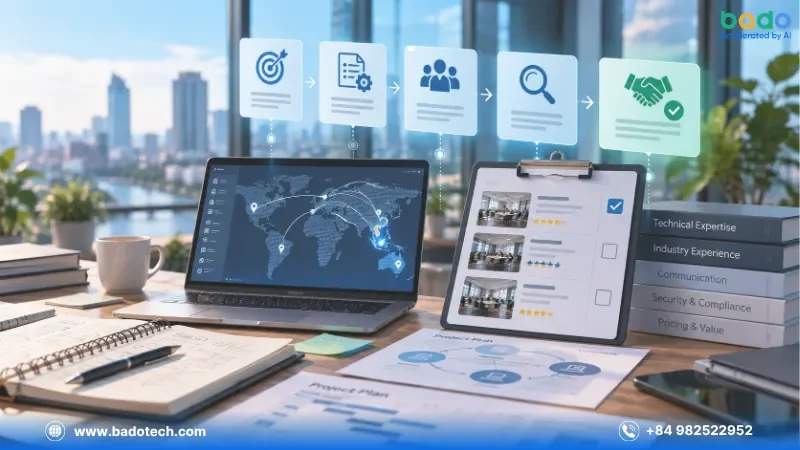
Evaluate Vendors Beyond Price
Once your requirements are clear, create a shortlist of potential software development partners. Review their relevant project experience, technical capabilities, communication practices, security processes, and ability to support your product as it grows.
When assessing a vendor, ask how they handle requirement changes, code reviews, testing, documentation, deployment, and production issues. Request relevant case studies and discuss the team's actual role in previous projects rather than relying solely on portfolio screenshots or general claims.
Understanding how to hire software developers also means evaluating the people who will work on your project. Confirm their technical expertise, English communication skills, experience with your industry or product type, and availability. A technically strong team that cannot communicate effectively or understand your business priorities may create costly delays.
For international businesses considering Vietnam, a software outsourcing Vietnam guide should look beyond labor costs. Evaluate the talent pool, time-zone overlap, English communication, management practices, intellectual property protection, and experience working with overseas clients. These factors help explain why outsource software development to Vietnam can be a practical option for businesses seeking an external engineering partner, although the right choice ultimately depends on the individual vendor and project.
How to Manage Software Outsourcing for Quality, Security, and Long-Term Results
Selecting a vendor is only the beginning. Effective software outsourcing depends on how both parties manage the project, communicate decisions, control risks, and measure progress. A structured collaboration process helps prevent misunderstandings and keeps development focused on business outcomes.
Establish Clear Communication and Project Governance
Agree on responsibilities before development starts. Define who owns product decisions, approves deliverables, manages the backlog, resolves technical issues, and communicates changes. Establish a regular meeting schedule and select shared tools for project tracking, documentation, and communication.
A practical workflow may include weekly progress reviews, sprint planning, demonstrations, and regular technical updates. These practices help stakeholders identify blockers early and make decisions before small issues become major delays.
For distributed teams, document important requirements and decisions instead of relying entirely on verbal discussions. Clear documentation reduces ambiguity across time zones and makes it easier for new team members to understand the project.
Protect Quality, Security, and Intellectual Property
Quality assurance should be integrated into the development process rather than postponed until the final release. Agree on coding standards, code review procedures, automated testing expectations, acceptance criteria, and release requirements. For business-critical software, also consider performance, reliability, maintainability, and recovery procedures.
Security and intellectual property protection require the same attention. Before sharing sensitive information or granting system access, establish appropriate confidentiality agreements, access controls, data-handling rules, and contractual ownership of deliverables. Review the vendor's security practices against your business and regulatory requirements.
You should also agree on how source code, technical documentation, credentials, and deployment environments will be managed. These details reduce dependency on a single vendor and make future maintenance or team transitions more manageable.
Track Progress Through Business-Focused KPIs
Measure the success of an outsourcing engagement using indicators that reflect delivery quality and business value. Depending on the project, useful measures may include milestone completion, defect rates, deployment frequency, lead time for changes, production incidents, and adherence to agreed service levels.
For product development, you may also track activation, adoption, conversion, or user retention after launch. These metrics help connect engineering work to business performance instead of measuring success only by the number of tasks completed.
Avoid relying on a single metric. Faster delivery, for example, is not necessarily an improvement if it increases defects or creates technical debt. Review performance regularly and use the findings to adjust priorities, resources, and processes.
Build a Partnership That Can Scale
Business needs often change after the initial release. New customer requirements, market opportunities, and technical challenges may require additional expertise or a different team structure.
When planning for growth, discuss how the vendor handles knowledge transfer, onboarding, team expansion, staff replacement, and ongoing maintenance. A reliable partner should be able to explain how it preserves project knowledge and maintains delivery continuity as the team evolves.

Consider future skill requirements as well. Depending on your roadmap, you may need AI engineers to integrate intelligent features, mobile developers to build iOS or Android experiences, or DevOps engineers to improve deployment automation, cloud infrastructure, and system reliability.
Planning these capabilities early helps you scale deliberately rather than making rushed hiring decisions when new requirements emerge.
Bado Tech Supports Your Software Outsourcing Journey
Bado Tech works as a Vietnam-based product engineering partner, offering flexible software development services for businesses that need to build, extend, or scale digital products.
Dedicated Developers and IT Staff Augmentation
When your internal team needs additional engineering capacity, dedicated developers and IT staff augmentation can help you bring in relevant technical skills without managing a lengthy recruitment process for every role.
This approach is suitable for businesses that already have product leadership or technical management in place and need additional support to execute their roadmap. Team composition can be aligned with the expertise and capacity required for the project.
Dedicated Development Teams and Product Development
For businesses building or scaling a digital product, a dedicated development team provides a more continuous approach to engineering collaboration. Product development services support the broader journey from discovery and planning through implementation, deployment, and ongoing improvement.
This model can be useful when you need a team that develops a deeper understanding of your product, maintains technical continuity, and adapts as requirements evolve.
Rapid MVP Development and AI Engineering
If you are validating a new business idea, rapid MVP development helps focus the initial release on essential functionality and early market feedback. This can give your team a more practical foundation for deciding what to improve or expand next.
For products that require intelligent capabilities, Bado Tech's AI Engineering service covers AI-powered software involving machine learning, large language models (LLMs), and intelligent automation. The appropriate solution depends on your use case, data readiness, integration needs, and business objectives.
Find the Right Engagement Model with Bado Tech
Bado Tech's service includes dedicated developers, dedicated development teams, rapid MVP development, product development, AI engineering, and IT staff augmentation. Rather than choosing a model based on its name alone, businesses should align the engagement with their project scope, internal capabilities, expected duration, and level of delivery ownership.
Ready to discuss your software development project? Share your business objectives, current challenges, and expected outcomes with Bado Tech. The team can help you explore a suitable engagement approach and identify the capabilities needed to move your project forward.
Contact Bado Tech to discuss your software outsourcing requirements and next steps.
Conclusion
Successful software outsourcing goes beyond reducing costs. It requires choosing the right engagement model, setting clear expectations, and partnering with a reliable team that understands your business goals. With the right approach, businesses can access specialized expertise, accelerate product development, and scale more efficiently. Explore Bado Tech's software development services or contact our team to find the right outsourcing solution for your business.
Frequently Asked Questions
1. Which software outsourcing model is best for my business?
The best model depends on your requirements. Project-based outsourcing suits well-defined deliverables, staff augmentation adds expertise to an existing team, and a dedicated development team supports ongoing product development.
2. Why outsource software development to Vietnam?
Vietnam may be a suitable outsourcing destination for businesses seeking access to software engineering talent and flexible delivery arrangements. However, vendor experience, communication, security, and project management should be evaluated alongside cost.
3. How much does it cost to outsource software development?
Costs vary depending on project complexity, team size, technical expertise, engagement model, and duration. Businesses should compare the total cost of delivery, including maintenance and potential rework, rather than evaluating hourly rates alone.