

Building a Minimum Viable Product (MVP) is often the first major step in turning a software idea into a working product. At this stage, businesses need enough technical resources to develop essential features, test the product with real users, and collect feedback without spending too much on unnecessary development.
One of the first questions founders and business owners face is: how many developers does an MVP need? Should they start with one full-stack developer, hire separate frontend and backend specialists, or assemble a complete development team?
The answer depends on the product's complexity, technical requirements, available budget, and expected launch timeline. Rather than hiring as many developers as possible, businesses should build a team that can deliver the core product efficiently while leaving room for future improvements.
How Many Developers Does an MVP Actually Need?
Most MVP projects can start with 2–3 developers, although a particularly simple product may require only one experienced full-stack developer. More complex applications involving multiple integrations, mobile platforms, or advanced technical requirements may need a larger team. The goal is not to build the smallest possible team at any cost. It is to find the right balance between development capacity, technical expertise, and coordination.
A Practical Team Size Based on MVP Complexity
Different MVPs require different levels of development effort. A simple application with limited functionality does not need the same resources as a multi-platform SaaS product. The following breakdown provides a practical starting point:
These figures refer to developers only, not the entire project team. Other specialists may contribute part-time or throughout specific development phases. For example, a simple booking application may need one full-stack developer and occasional UI/UX support. However, a SaaS platform with user authentication, subscription management, reporting, and multiple integrations may require separate frontend and backend expertise.
The important consideration is whether the team can handle the required workload without creating bottlenecks or compromising software quality.
What Roles Should an MVP Development Team Include?
Developers are responsible for turning product requirements into working software, but successful MVP delivery involves more than coding. Several supporting roles help ensure that the product is usable, reliable, and aligned with business objectives. A lean MVP development team may include:
- Full-Stack Developer: Handles both frontend and backend development, making this role particularly useful for smaller projects.
- Frontend Developer: Builds the user interface and ensures the application works smoothly across devices and screen sizes.
- Backend Developer: Develops server-side logic, APIs, databases, authentication, and business processes.
- UI/UX Designer: Creates user flows, wireframes, and interfaces that make the product easy to understand and use.
- QA Engineer: Identifies bugs, tests critical user journeys, and checks whether the product meets its requirements.
- Project Manager or Product Owner: Coordinates priorities, manages delivery, and ensures the development team stays aligned with business goals.
Not every MVP needs a dedicated person for each position. In smaller projects, one specialist can cover multiple responsibilities, while design, QA, and project management can be provided on a part-time basis. The key is to ensure that every critical responsibility has a clear owner before development begins.
What Determines the Number of Developers Your MVP Needs?
Two businesses may have similar product ideas but require completely different development resources because of differences in technical architecture, integrations, user expectations, and delivery constraints. Before deciding how many developers to hire, consider these five factors.
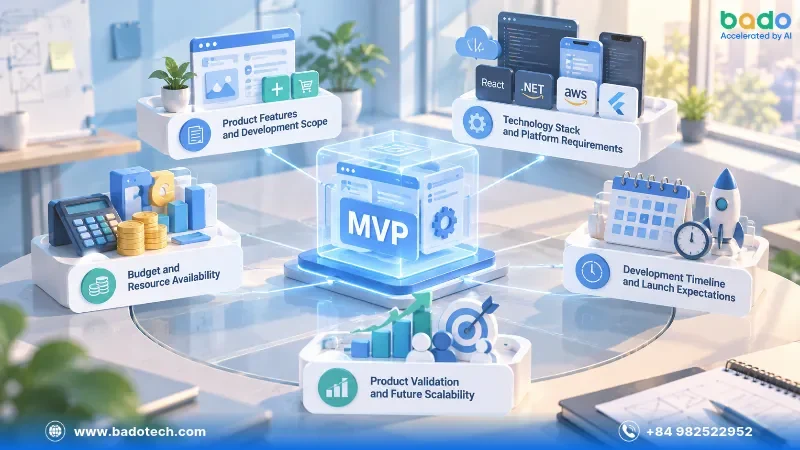
Product Features and Development Scope
The number and complexity of features directly affect development workload. An MVP should focus on the essential functionality needed to validate its core business idea rather than attempting to deliver a complete product from day one.
For instance, an MVP for an online marketplace may initially include user registration, product listings, search, and basic ordering. Advanced recommendation engines, automated promotions, and complex analytics can be introduced in later releases.
A clearly prioritized feature list helps developers estimate the workload and identify which technical skills are actually required.
Technology Stack and Platform Requirements
The technologies used to build an MVP also influence team composition. A web application, mobile application, and cross-platform product may require different development expertise. For example:
- Web MVP: May require React or Vue.js developers for frontend development and .NET or Node.js developers for backend services.
- Mobile MVP: May require Flutter developers or separate native iOS and Android expertise.
- SaaS MVP: Often requires additional attention to authentication, database design, API development, and cloud infrastructure.
- AI-powered MVP: May require AI engineers with experience in LLM integration, data processing, and third-party AI APIs.
Businesses should select technologies based on product requirements and long-term technical considerations rather than choosing a stack simply because it is popular.
If internal technical knowledge is limited, working with experienced specialists through software development services can help businesses evaluate the appropriate technical direction.
Development Timeline and Launch Expectations
A shorter launch timeline may require additional development capacity, especially when several features can be developed independently.
However, adding more developers does not automatically make an MVP faster. New team members need onboarding, technical context, code reviews, and coordination. If the project is not structured properly, a larger team may introduce additional communication overhead.
Instead of increasing headcount immediately, businesses should identify the actual delivery bottleneck. If backend development is slowing down the project, adding another backend specialist may be more effective than hiring developers across unrelated areas.
Budget and Resource Availability
Budget determines not only how many developers a business can engage but also how long it can maintain the team. Hiring multiple full-time developers may not be financially practical for an early-stage business that has not yet validated its product idea. In this situation, a smaller team with broader technical capabilities can be a more suitable starting point.
For SMEs, software outsourcing for SMEs can provide access to specialized developers without requiring permanent recruitment and long-term employment commitments.
Businesses should also consider the overall software outsourcing cost, including development, project management, testing, infrastructure, and ongoing maintenance. A lower initial team cost does not necessarily mean a lower total cost of ownership.
Product Validation and Future Scalability
An MVP is designed to test assumptions, not necessarily to support every future business requirement. If the product gains traction, the development team may need to expand to handle additional users, integrations, security requirements, and new functionality.
This is why businesses should distinguish between building an MVP and preparing a product for long-term growth. The initial team should be able to deliver a functional first release without creating technical limitations that make future development unnecessarily difficult.
From MVP Concept to Market-Ready Product With Bado Tech
Turning an MVP concept into a working product requires more than assigning developers to a list of tasks. Businesses need a development approach that connects product requirements, technical decisions, and delivery resources throughout the project.
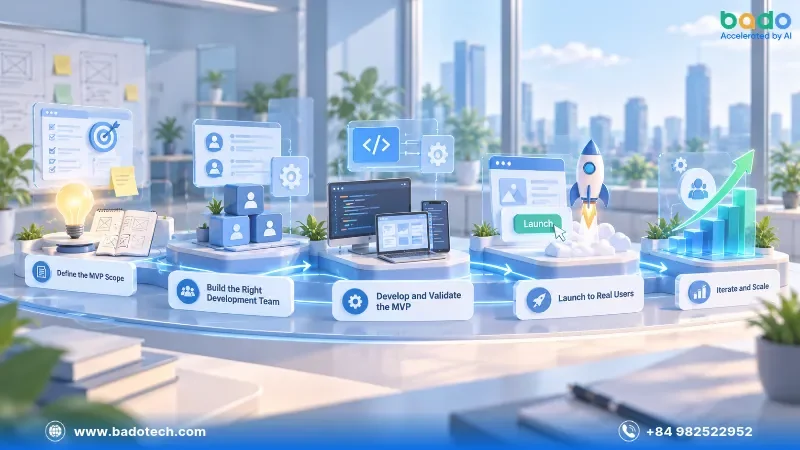
Bado Tech supports this process through Rapid MVP Development, dedicated developers, and dedicated development teams. Rather than applying a fixed team structure to every project, the approach focuses on matching technical capabilities with the product's actual requirements.
Define the MVP Scope Before Assigning Development Resources
The first step is understanding what the product needs to achieve. Without a clearly defined scope, businesses risk allocating too many developers to low-priority features or underestimating the technical effort required for essential functionality.
Bado Tech's MVP development approach considers project scope, technical requirements, and delivery goals when determining the appropriate team composition.
For reference, Bado Tech identifies 3–10 people as a typical MVP development team size, with an estimated engagement duration of 2–6 months. The actual structure depends on the project rather than a fixed staffing formula.
A team may combine frontend and backend developers with project management, design, and QA support. For more technically demanding products, additional expertise can be introduced when required. This helps businesses establish a practical development plan before committing resources.
Select the Right Development Setup for Your Business
Once the project scope is clear, businesses need to determine how development responsibilities should be organized. Depending on existing resources and project requirements, businesses can consider different engagement models:
- Dedicated Developers: Suitable for businesses that already have an internal team but need additional frontend, backend, full-stack, or QA expertise.
- Dedicated Development Team: Appropriate for businesses that need a coordinated team to manage ongoing product development and future improvements.
- Project-Based Outsourcing: A practical option when the scope, deliverables, and expected timeline are clearly defined.
For example, a business with an existing product manager and designer may only need two or three external developers to complete its MVP. Another business without technical resources may benefit from a more complete development team.
Businesses considering when should SMEs outsource software development should evaluate internal capabilities, project complexity, and the level of technical ownership required before selecting an engagement model.
You can also explore Bado Tech's Dedicated Development Teams to understand how a structured team can support product development beyond the initial MVP stage.
Prepare for the Next Development Stage After Launch
An MVP launch provides the first opportunity to evaluate how users interact with a product. Their feedback can reveal which features need improvement, which workflows create friction, and what additional functionality should be prioritized.
As the product evolves, the development team may need to expand its capabilities. A project that initially requires two full-stack developers may later need dedicated frontend, backend, QA, and DevOps specialists.
Bado Tech supports this progression through flexible development resources and AI-augmented engineering workflows. By combining experienced developers with AI-supported processes, businesses can improve development efficiency while maintaining human oversight of technical decisions and software quality.
This creates a development path that allows businesses to move beyond the initial MVP without having to rebuild their entire team structure.
Planning your MVP development project? The right team starts with a clear understanding of your product, technical requirements, and business objectives. Bado Tech can help you assess your development needs and identify a suitable team structure for your next project. Contact us to discuss your MVP project.
Conclusion
Ultimately, the right team size depends on what you are building, how quickly you need to launch, and what resources are available. Start with the essential capabilities, assign clear responsibilities, and expand the team when product requirements justify additional expertise.
A well-structured MVP team helps businesses validate ideas efficiently while creating a foundation for future product development.
Frequently Asked Questions
1. Can one developer build an MVP?
Yes. One experienced full-stack developer can build a simple MVP with limited features and technical complexity. However, additional support may be needed for UI/UX design, testing, and infrastructure.
2. How long does it take to build an MVP?
The timeline depends on product scope, technical complexity, and team capacity. Bado Tech lists 2 - 6 months as a typical engagement duration for its MVP development teams.
3. Should businesses hire developers in-house or outsource MVP development?
In-house hiring offers direct control and long-term internal knowledge. Outsourcing provides access to external expertise and flexible resources. The right choice depends on budget, internal capabilities, and project requirements.